Affiliate disclosure: Some of the links on this page are affiliate links. If you click through and make a booking, we may earn a small commission at no extra cost to you. This helps keep this website completely free and independent.
Is London Safe for Tourists?
London is the third most visited city on earth. Roughly 23 million international tourists came in 2025. The vast majority went home without incident. That fact alone tells you something useful — but it does not tell you everything, and this page will not pretend otherwise.
London is safe. It is not, however, crime-free, and a handful of specific risks have become more pronounced in recent years. The tourists who get into trouble in London are almost always the ones who were not paying attention. The ones who arrive informed and alert almost never are.
There is no benefit in being naïve, and there is no benefit in being alarmed. What matters is being properly informed.
For official advice, the US State Department currently rates the UK at Level 2 — "exercise increased caution" — largely because of a general terrorism threat. The UK's own Home Office sets the national terrorism threat level at "substantial", meaning an attack is considered likely. That sounds alarming. It should be kept in perspective: London has not experienced a major terrorist incident since 2017, and the city's security services are among the most experienced in the world at preventing them. It is a risk to be aware of, not a reason to stay home.
How London Actually Compares
The numbers on violent crime in London are considerably better than the headlines suggest. In 2025, London recorded 1.1 homicides per 100,000 residents — lower than Paris at 1.6, Brussels at 2.9, and Berlin at 3.2. Metropolitan Police figures show that the first nine months of 2025 saw the fewest homicides since monthly records began in 2003. For context: London's murder rate is a fraction of almost any comparable American city.
Knife crime gets substantial media coverage in the UK, and the coverage is not entirely wrong — it is a persistent problem in certain parts of the city. But the crucial context almost always goes unreported: knife crime in London is overwhelmingly concentrated among young men in specific deprived neighbourhoods - some outer suburbs to the east and south of London. It is overwhelmingly connected to gang activity and disputes between people who already know each other. Tourists are not the target. A visitor to London is unlikely to be anywhere near a knife crime incident unless they have made some very poor decisions about where to spend their evening.
What tourists are realistically at risk from is theft. London has a genuine and worsening problem with opportunistic theft, and if you visit the city without understanding this, you are making it easier to become a statistic.
The Phone Snatching Epidemic
This is the thing most travel guides still underplay, and it deserves to be said plainly: walking around London with your phone held out in front of you is an invitation to have it stolen. Approximately 80,000 mobile phones were reported stolen in London in 2024. Organised gangs operate on electric bikes and scooters, targeting pedestrians who are looking at their screens. They move fast, they are practised, and by the time you have processed what happened they are gone.
The solution is simple: do not walk around looking at your phone. Check your map, then put it away and walk. Do not stand on a pavement looking at your screen. If you must use your phone in public, step inside a shop doorway, position your back against a wall, and be aware of who is around you. Do not use your phone while waiting at a bus stop or standing on a Tube platform. This is not excessive caution — it is the reality of London.
Pickpockets and the Tourist Trail
There is a cruel irony in London tourism: the places you most want to visit are the places you most need to guard your belongings. Oxford Street, Leicester Square, Covent Garden, Borough Market, the South Bank, Westminster — these are the prime operating grounds for pickpockets, precisely because they are crowded with distracted visitors. Pickpockets work in pairs and groups, often using a brief physical contact or a minor disturbance to cover the moment a hand goes into your bag or pocket.
A money belt is not a bad idea. At minimum, keep your wallet in a front pocket, keep your bag zipped and held in front of you in crowds, and never leave a bag hanging on the back of a chair in a café or restaurant. A bag on a chair back is a bag that is about to disappear.
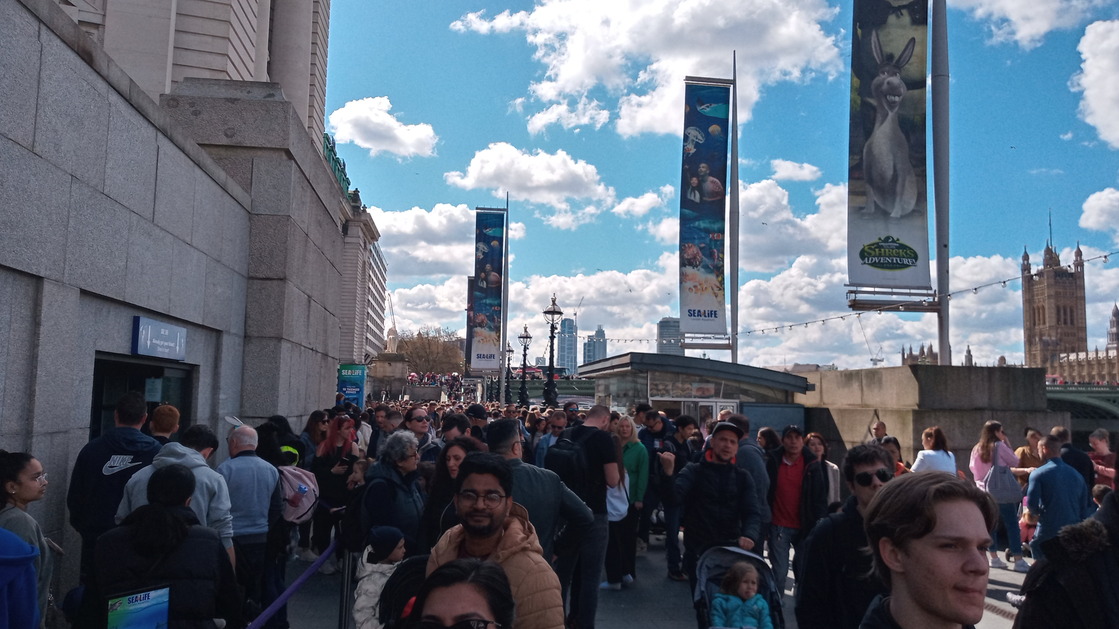
Wherever there are crowds like this in London there is the risk of a pickpocket operating. This is on the Southbank, with the London Eye behind us and the Houses of Parliament to the right across the river.
Areas Worth Knowing About
London has no zone so dangerous that tourists should flatly avoid it. But some areas require more awareness than others, particularly after dark.
Parts of east and south London — certain estates in Hackney, Peckham, Brixton late at night, and some areas around Elephant and Castle — have higher concentrations of street crime than the tourist zones. This does not mean you should never visit them; Brixton's market and Peckham's restaurant scene are worth your time. It means you should visit during the day, stay on well-lit main streets in the evening, go in a group, and not wander down unlit side streets.
Camden is lively and fun and can feel edgy late on a Friday night, which is part of its appeal. It is also a place where you should keep a close eye on your belongings and your drink. Soho and Shoreditch are similar — excellent for an evening out, but not somewhere to become careless.
The areas most tourists spend most of their time in — Westminster, South Kensington, Covent Garden, the South Bank, the City of London — are genuinely well-policed and as safe as anywhere in central London. The safest areas in the city tend to be the busiest ones. CCTV coverage in central London is among the most comprehensive of any city on earth.
The Taxi Question
London has two legitimate options for taxis: the iconic black cab, whose drivers undergo years of training to memorise the entire city centre (a qualification called "The Knowledge"), and licensed private hire apps such as Uber. Use one of these two. Do not get into an unlicensed minicab, no matter how cheap or convenient it seems, no matter who approaches you outside a pub or club offering a ride. Unlicensed taxi assaults are a documented problem in London. It is not worth the risk.
If you use Uber or a similar app, check the number plate of the car against what the app shows you before you get in. This takes just five seconds and it matters.
One Thing Americans and Europeans in Particular Must Know
Look right before you cross the road. Traffic in the UK drives on the left, which means it comes from your right. Research suggests that 61 percent of pedestrian accidents in London involve visitors, almost all of them because of this reflex error. Many central London crossings are painted with "LOOK RIGHT" on the road surface. Take it seriously. It is the most predictable way a tourist gets seriously hurt in London, and it is entirely preventable.
Scams in London that target Tourists
Before you get to the attractions themselves, a word about the people you will meet outside them.
Outside the Tower of London, Westminster Abbey, and several other major paid attractions, you will encounter ticket touts and "tour guides" offering to sell you tickets, jump the queue, or provide a private tour for cash. The tickets are frequently fake, overpriced, or for the wrong day. The tours are unregulated. If you buy a ticket from someone on the street and it fails to scan at the entrance — which is the most common outcome — you will receive no refund, no sympathy, and no recourse. Buy tickets only from the official attraction website or from the official ticket desk inside the attraction. The slight inconvenience of waiting in the ticket queue is considerably less than the inconvenience of having lost £40 to a scammer.
A separate and more sophisticated scam operates around Trafalgar Square, Covent Garden, and Leicester Square: people dressed as characters — superheroes, film characters, historical figures — who invite tourists to pose for a photograph and then demand aggressive payment for the privilege. They are not buskers. They are not charming. If someone in a costume approaches you, keep walking. If you have already posed and they are demanding money, you are not legally obliged to pay. Hand over nothing and walk away.
Another scam is street entertainers who put on a show. (Ed Sheeran, Tracey Chapman and Rod Stewart were once buskers on the streets of London.) Some buskers, mimes or magicians are genuine in their intent, but some are not. The latter are part of a gang who get people to stop, then usher them together, a gang member in the crowd then pickpockets these people. If you want to watch such a spectacle, keep back from the crowd, ideally with your back against a wall: watch your bag and pockets.
In the same category: the men outside Buckingham Palace offering to sell you "official" royal souvenirs. There is no such thing as an official souvenir sold by a man from a bag on the pavement.
Essential London Safety Tips — Do Not Ignore
- Do not walk around looking at your phone. Check your map, put it away, then walk. E-bike phone snatchers operate throughout central London.
- In any crowd — Tube carriages, markets, tourist attractions — keep your bag zipped and held against your body. Never leave it on the back of a chair.
- Only use black cabs or licensed app-based taxis. Never accept a ride from an unlicensed minicab driver who approaches you.
- Look right before crossing any road. Then look left. Then look right again. Do not assume the traffic patterns are the same as home.
- The Tube is safe and is the best way to get around. Be alert to pickpockets on crowded lines — the Central, Northern, and Jubilee lines through central London in rush hour are prime territory. Rush hour in London is broadly 7:30–9:30am and 5–7pm.
- Do not accept drinks from strangers in bars and clubs. Drink spiking has been a reported problem at London nightlife venues. Keep your drink in your hand.
- Avoid isolated streets and unlit parks after dark, even in central boroughs. Stick to main roads and well-lit areas.
- If you are lost, ask. Londoners have a reputation for being reserved, but they are generally helpful when approached politely and directly. A police officer is always a good choice — Metropolitan Police officers are unarmed, visible in tourist areas, and approachable.
- If your phone or wallet is stolen, report it to the police. Call 101 (the non-emergency number) or report it online at the Met Police website. Get a crime reference number — you will need it for any insurance claim.
- Tap water in London is safe to drink. It tastes hard — high in calcium and magnesium — but it will not make you ill. You do not need to buy bottled water.
- If you have a genuine emergency, call 999. This connects to police, ambulance, and fire services.
London is a city of nine million people with all the complexity that implies. Most of those people live their lives in safety every day, and so will you — if you pay attention. The tourists who love London are the ones who arrived knowing what to watch for, and then got on with the business of exploring one of the finest cities in the world.
Do You Really Need Travel Insurance for London?
The NHS provides emergency treatment, but it does not guarantee everything will be free. Depending on your situation, overseas visitors can still be charged—especially once care moves beyond the immediate emergency stage.
If you’re travelling with a GHIC or EHIC, you’ll get access to medically necessary state care, but that comes with limits:
- No cover for private treatment
- No cover for getting you home (repatriation)
- No cover for cancellations, delays, or lost belongings
In practical terms: you’ll be looked after—but you’re still financially exposed.
Where Travel Insurance Makes the Difference
Most problems travellers face aren’t major emergencies. They’re the frustrating, expensive situations around the edges—missed connections, extended stays, follow-up treatment, or needing to change plans quickly.
Without insurance, those costs fall directly on you. With it, they’re handled.
It’s not about expecting something to go wrong. It’s about not having to deal with it alone if it does.
The link below is an affiliate link. If you make a purchase through them, we may earn a small commission at no extra cost to you.
Compare Travel Insurance OptionsVisitorsCoverage lets you compare multiple travel insurance providers all in one place. It is particularly well suited to US travellers, while offering options for all nationalities. You can choose just medical cover or just trip insurance or both. This marketplace offers many options to suit every wallet.
Compare your insurance options here →Typical Situations Where Insurance Helps
- Flight delays forcing an unexpected overnight stay
- Follow-up treatment after an emergency visit
- Lost or delayed luggage requiring replacement essentials
- Cutting your trip short due to illness or family emergencies
What It Could Cost Without Insurance
- Short hospital stay: hundreds to thousands of pounds
- Medical evacuation or repatriation: potentially tens of thousands
- Last-minute flight changes: significantly higher fares
- Replacing lost belongings: entirely out of pocket