Affiliate disclosure: Some of the links on this page are affiliate links. If you click through and make a booking, we may earn a small commission at no extra cost to you. This helps keep this website completely free and independent. Thank you for your support.
The London Practical Guide: Money, Electrics, Emergencies, Water, Manners & Customs
The things that derail a trip are rarely the big ones. You planned for those.
It’s the small, assumed, “nobody-told-me” details — the socket that won’t accept your charger at midnight, the card declined because the machine expects a PIN you’ve never set, or the 999 call you weren’t sure was the right one — that create the real friction and stress.
This page gives you a clear, logical checklist so nothing small spoils your London trip. We start with the two big pre-trip decisions (money and gear), move into travel insurance, then cover exactly what to do if you need medical or emergency help, and finish with the everyday British customs that make you feel at home instead of like an ignorant outsider.
Money — What to Bring, How to Pay, What Not to Do
The currency is Pound Sterling, abbreviated as GBP and written as £. It is not the Euro. It has never been the Euro. This continues to confuse a surprising number of visitors. Euros are not accepted anywhere in the UK, and any establishment that offers to take them is doing so at an exchange rate that makes it a terrible deal for you.
London is one of the most cashless societies on earth. Contactless card payment is accepted almost universally — in supermarkets, pubs, taxis, market stalls, museums, and most street food vendors. Many businesses have become entirely cash-free since 2020 and will decline to serve you if you offer a note. You can visit London for a week and never need to handle a banknote.
That said, carry a small amount of cash — £40 to £60 — for situations where it is needed: some church collections, some market stalls, car park machines, the occasional tip. Withdraw it from a cashpoint (ATM) inside a bank or supermarket, not from a standalone machine on the street, and emphatically not from a currency exchange desk at the airport. The airport exchange desks offer rates that range from poor to predatory.
When paying by card in a restaurant, the correct phrase is "Can we pay, please?" The machine will be brought to the table. You tap or insert your card at the machine. You do not hand your card to a member of staff and let it disappear to a back room; it might be cloned. If someone takes your card away from you, that is not standard British practice and you should say so.
Tipping is customary in restaurants — 10 to 12.5 percent for decent service, the full service charge if it is already on the bill and the service merited it, nothing extra on top of a service charge already added. Tipping in pubs is not expected. Taxi drivers expect rounding up to the nearest Pound or a modest tip on longer journeys; they do not expect American-style percentages.
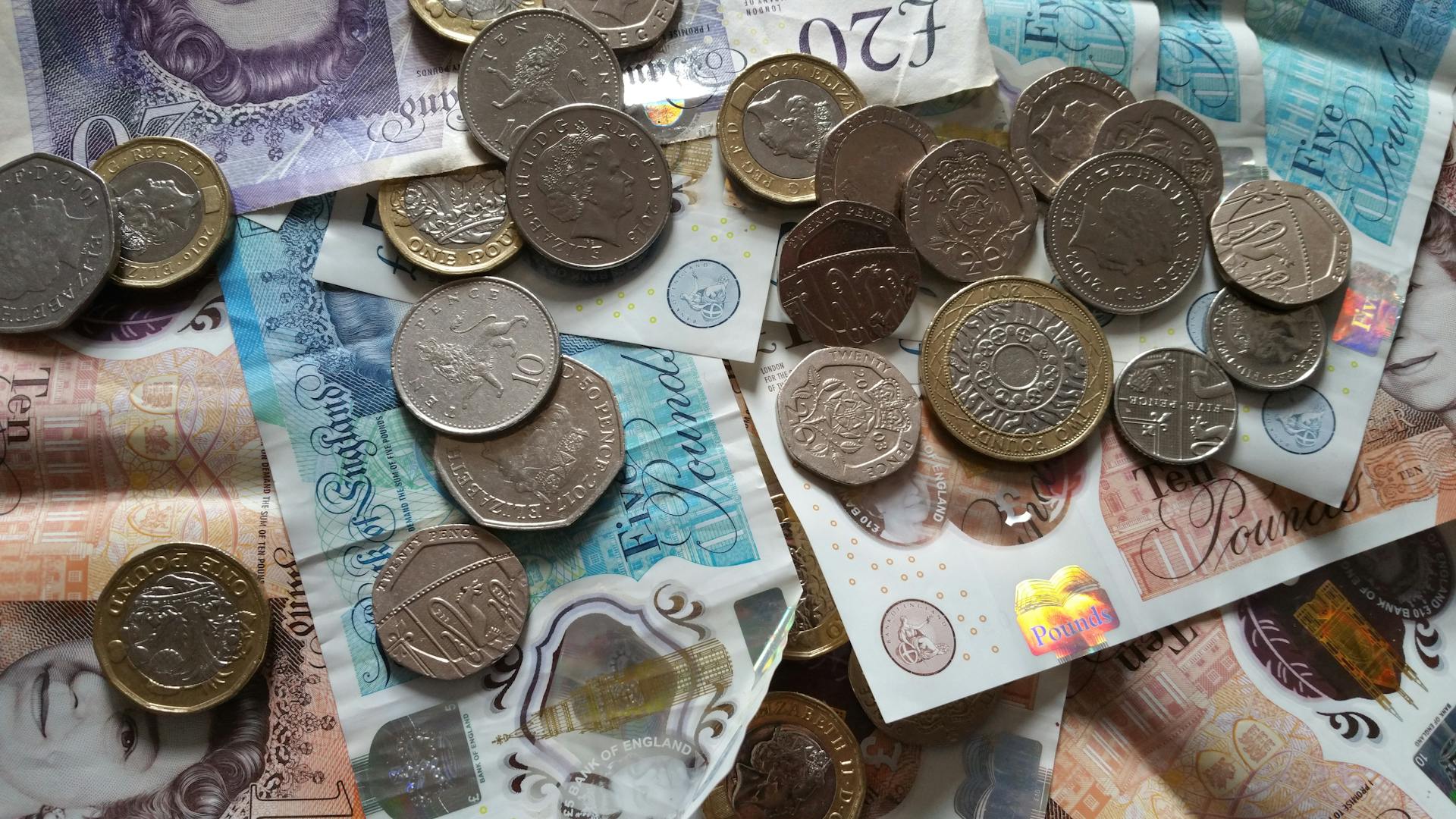
The British Pound Sterling comes in £5, £10, £20 and £50 notes. Coins are pence: 1p, 2p, 5p, 10p, 20p and 50p. There is also £1 and £2 coins that are useful as all sorts of machines expect these. All money with images of late Queen Elizabeth II on them are still valid tender for the foreseeable future but are gradually being replaced with notes and coins with the image of King Chales III.
The Wise card for London — what your bank doesn't want you to know
London is one of the most cashless cities on earth. You will tap your card for the Tube, buses, coffee, lunch, dinner, museum entry, theatre tickets, a round at the pub. All of it. If you carry cash in London you'll largely find it unnecessary. The card you tap, however, matters.
Every time you use a regular bank card abroad, your bank applies its own exchange rate — not the real one, the one with their margin built in (3-5%) — and then still adds a "foreign transaction fee" on top. Neither charge appears as a line item. It all just silently leaves your account. In a city where you're tapping ten, fifteen times a day, that invisible cost accumulates fast.
The Wise card fixes this. Before you travel, you transfer what you plan to spend from your bank into your Wise account. Wise gives you a card — physical, Apple Pay, Google Pay — and from that point it works exactly like any other contactless card. Tap the Tube barriers, tap at the checkout, tap at the bar. The difference is that every transaction clears at the real mid-market rate, the rate you'd find on Google, with no "foreign transaction fee". The money you save on a two-week London trip is tangible.
The app is where the other benefit lives. Every transaction triggers an instant notification and updates your balance in real time. Your spending is categorised automatically — transport, food, shopping. You loaded what you planned to spend; you can see exactly how much of it remains. There's no end-of-trip shock when your bank statement arrives. You knew where you stood every day. If needed, you add more money onto the Wise card via the app, in minutes.
For the rare moments you need cash — a market, a small shop — the Wise card is also the cheapest way to use an ATM (Cash Machine in British English). You get a free monthly withdrawal allowance at the real exchange rate. Just always select to withdraw in Pounds Sterling when the ATM gives you the option, never in your home currency.
One more thing: if your card is lost or stolen, you freeze it instantly in the app. And because Wise is a separate account from your main bank, a thief can only ever reach the balance you loaded. Your bank account is completely out of their reach.
Get the Wise card before your London trip →Affiliate link — I may earn a small fee if you sign up, at no cost to you. I use Wise myself when I travel. There is a surprise gift that comes with my link.
With your money and cards sorted, the next thing almost every traveller forgets to check before packing is something far more basic: electricity.
Electrical Sockets and Voltage
The United Kingdom uses a socket unlike almost anywhere else on earth: the Type G, a large three-pin plug in a rectangular configuration. It is arguably the safest electrical plug design in the world — the pins are partially insulated, the socket has protective shutters, and it is very difficult to electrocute yourself accidentally. None of this is any comfort when you arrive with American, European, or Australian plugs and nothing to put them in.
Buy a UK travel adapter before you leave home. The ones sold in airport departure lounges are the same product at three times the price. One universal adapter covering the UK Type G is sufficient for most travellers. If you are bringing multiple devices, a travel power strip with a single UK plug on one end and multiple USB and standard sockets on the other solves the problem entirely from a single adapter.
UK mains voltage is 230V at 50Hz. American devices are built for 110–120V. Most modern electronics — laptops, phone chargers, camera batteries — are dual-voltage and will handle 230V automatically. Check the fine print on the charger itself: if it says "Input: 100–240V" you are fine. If it says "Input: 120V" only, it will not work and may be damaged. Hair dryers, electric shavers, and certain other appliances are the most common culprits. A UK-purchased travel hair dryer costs less than a replacement for a blown one. A "step-down" converter might prevent your cherished appliances being damaged.
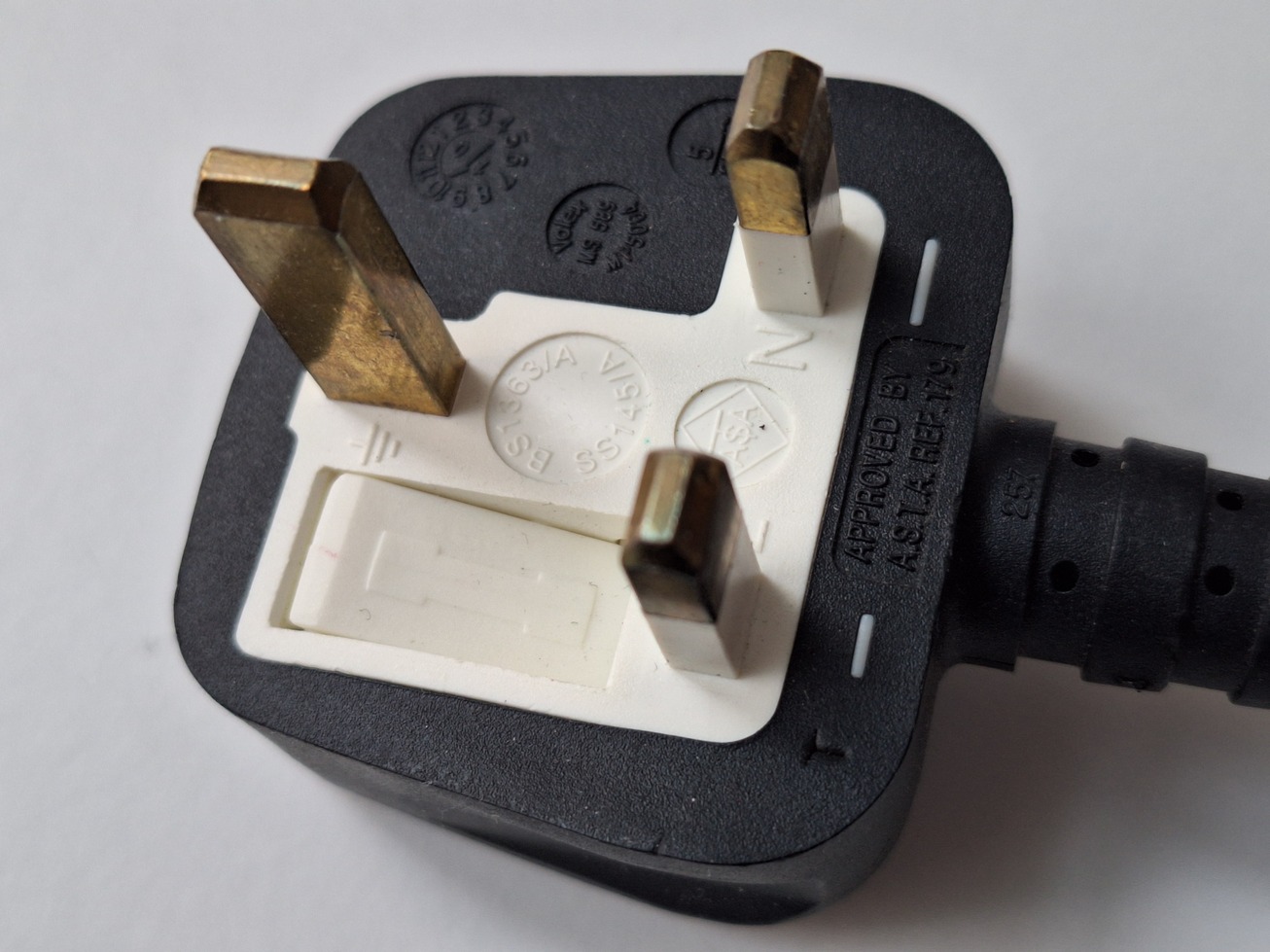
The British electrical plug is perhaps the safest in the world. Finding an adapter, especially a step-down converter-adapter, might take longer than you think.
Now that your finances and chargers are ready, there’s one more important pre-trip decision: whether you actually need travel insurance for London.
Travel Insurance — Do You Really Need It for London?
The NHS provides emergency treatment, but it does not guarantee everything will be free. Depending on your situation, overseas visitors can still be charged—especially once care moves beyond the immediate emergency stage. People from the USA, Canada, Australia and New Zealand are often surprised that no healthcare treaty exists with the UK.
If you’re from an European country and are travelling with a EHIC card, you’ll still get access to medically necessary state care, but even that comes with limits:
- No cover for private treatment
- No cover for getting you home (repatriation)
- No cover for cancellations, delays, or lost belongings
In practical terms: you’ll be looked after—but you’re still financially exposed.
Where Travel Insurance Makes the Difference
Most problems travellers face aren’t major emergencies. They’re the frustrating, expensive situations around the edges—missed connections, extended stays, follow-up treatment, or needing to change plans quickly.
Without insurance, those costs fall directly on you. With it, they’re handled.
It’s not about expecting something to go wrong. It’s about having peace of mind and not having to deal with it alone if it does.
The link below is an affiliate link. If you make a purchase through them, we may earn a small commission at no extra cost to you.
Compare Travel Insurance OptionsVisitorsCoverage lets you compare multiple travel insurance providers all in one place. It is particularly well suited to US travellers, while offering options for all nationalities. You can choose just medical cover or just trip insurance or both. This marketplace offers many options to suit every wallet.
Compare your insurance options here →Typical Situations Where Insurance Helps
- Flight delays forcing an unexpected overnight stay
- Follow-up treatment after an emergency visit
- Lost or delayed luggage requiring replacement essentials
- Cutting your trip short due to illness or family emergencies
What It Could Cost Without Insurance
- Short hospital stay: hundreds to thousands of pounds
- Medical evacuation or repatriation: potentially tens of thousands
- Last-minute flight changes: significantly higher fares
- Replacing lost belongings: entirely out of pocket
Whether you buy insurance or not, it’s useful to know exactly what to do if you need medical help while you’re in the city.
Health & Medical Emergencies
The National Health Service treats genuine emergencies regardless of nationality. If you are in a life-threatening situation — a serious accident, chest pains, a severe allergic reaction, a stroke — call 999 and an ambulance will come. You will be treated, no matter where in the world you are from. You will not be asked for a credit card in the emergency room. The NHS does not operate that way for emergency care.
For non-emergency medical issues, do not go to a hospital Accident and Emergency (A&E) department unless it is genuinely urgent. A&E departments in London can involve waits of four to eight hours for non-critical cases at weekends. Instead, use an NHS Urgent Treatment Centre or a walk-in clinic. The NHS website lists every walk-in and urgent treatment centre near your location.
The NHS 111 service — call or go online to 111.nhs.uk — connects you to a nurse-led triage service that will assess your symptoms and direct you to the right level of care. If you are unsure whether you need A&E, a walk-in clinic, a pharmacist, or simply rest and fluids, call 111 first. It is free, available around the clock, and will give you a clear answer.
Travel insurance with medical coverage is strongly recommended for all visitors. The NHS will treat emergencies, but follow-up care, repatriation, and anything beyond immediate stabilisation for non-EU, non-reciprocal agreement visitors will be chargeable. Check whether your home country has a reciprocal healthcare agreement with the UK before you travel — Australia does; the United States does not.
Pharmacies — called chemists in the UK, not drug stores — are found on almost every "high street" - it's what the British call a main road with shops on it. The two big chains are Boots and SuperDrug. Pharmacists in the UK are qualified to advise on and dispense a wide range of treatments without a prescription, including some antibiotics. If you have a minor ailment that you would normally see a doctor for at home, the pharmacist is your first port of call here.
For any other kind of emergency — police, fire, lost passport, or just needing non-medical advice — here are the exact numbers you need.
Emergencies of Any Kind
📞 Key Numbers
999 — Police, fire, and ambulance. Genuine emergencies only. Works from any phone including one with no credit or a foreign SIM. Free.
101 — Non-emergency police. Report a crime that has already happened — theft, fraud, minor assault — where no one is in immediate danger. You will receive a crime reference number needed for insurance purposes.
111 — NHS non-emergency medical advice. Free, 24 hours, nurse-led triage.
If your passport is lost or stolen, report it to the police on 101, then contact your country's embassy or consulate in London. Know your own country's consular address before you travel. The US Embassy is in Nine Elms; the Australian High Commission is in the Strand; the Canadian High Commission is in Trafalgar Square.
With the serious stuff covered, let’s return to a simple daily question that surprisingly confuses a lot of visitors.
Drinking Water in London
Tap water in the UK is safe to drink. In London, it is treated to the highest standards and delivered to every tap in the city. It is hard water — high in calcium and magnesium — which gives it a slightly chalky taste and is why the inside of your kettle will accumulate limescale if you stay long enough. It will not make you ill. You do not need to buy bottled water. Carry a refillable bottle and fill it from any tap.
Finally, once the practical logistics are out of the way, here’s how to avoid the small social slip-ups that make you stand out as a tourist.
Manners and Customs
The queue is sacred. Joining a queue in the middle, walking past a queue to the front, or failing to join the queue at all and expecting service when others are waiting are all treated as serious social transgressions. This applies everywhere: bus stops, museum entrances, coffee shops, supermarket checkouts. The queue is not a suggestion. Things get ugly quickly if you jump the queue.
Escalators. Stand on the right, walk on the left. This is the rule on the London Underground and in most public spaces with escalators. If you stand on the left, someone will say "excuse me" with a politeness that conveys the exact opposite. Move to the right before the situation arises.
Apologising. The British habit of saying sorry when someone else walks into them is not self-abasement — it is a social lubricant that keeps nine million people moving through a dense city without constant confrontation. It will feel strange for approximately two days and then entirely natural.
Directness and irony. "Not bad" means quite good. "Quite good" means good. "Interesting" very often means the opposite. "I'm not sure that's entirely right" in a meeting means "you are wrong and I am being kind about it." Read the room, and when in doubt, ask.
Personal space. The British are not a physically demonstrative people with strangers. A handshake is the standard greeting in a professional context; a wave or nod is fine in a casual one. Do not hug people you have just met unless they initiate it. As for kissing someone you have just met - don't.
Pub kitchens. Pubs close their kitchens and often stop serving food, earlier than restaurants. If you want to eat in a pub, go before 8:30pm.
Restaurant etiquette. If you want the staff's attention in a British restaurant you do so with a hand gesture when making eye contact. It is acceptable to say "excuse me" as they pass you. Do not shout out across the floor as this disturbs the other patrons and annoys the staff. There is no telling what the waiting staff will do to your order if you shout out at them.
And the most important custom of all: say "please" and "thank you", always. The bus driver. The barista. The museum attendant who tells you the lift is out of order. London is a city of millions of transactions a day, and the ones that go well do so partly because both parties acknowledge each other as human beings. It costs nothing and returns more than you would expect.