
Affiliate disclosure: Some of the links on this page are affiliate links. If you click through and make a booking, we may earn a small commission at no extra cost to you. This helps keep this website completely free and independent. Thank you.
Where to Stay in Vienna as a Tourist
Vienna is a considerably more affordable hotel market than London or Paris, which does not mean it is cheap — it means that what you get for your money is substantially better. A mid-range hotel in Vienna at €150–200 per night will typically give you a room that in London would cost €280–350, in a building that has been maintained with Austrian thoroughness, in a neighbourhood that is safe, walkable, and well-connected. This is one of the city's less-advertised pleasures. You do not have to make painful compromises between location and quality the way you do in many comparable capitals.
Vienna divides itself administratively into 23 districts, numbered and broadly arranged in concentric rings from the 1st district outward. The 1st district is the historic centre — the Innere Stadt, surrounded by the Ringstrasse — and it is where most of the city's famous sights are concentrated. For tourists, districts 1 through 9 (the Inner Ring) cover essentially everything you need, and the excellent U-Bahn means no part of the inner city is more than 15–20 minutes from any other.
At a Glance — Vienna's Best Tourist Districts
Five areas account for almost all tourist accommodation worth recommending. The table below summarises the key differences. Scroll past for detailed write-ups on each.
| District | Best For | Price Guide | U-Bahn Access | Nearest Landmark | The Honest Word |
|---|---|---|---|---|---|
| 🏛️ Innere Stadt 1st District See Hotels → | First-timers; those who want everything walkable | €€€€ €200–400/night |
U1U3 Stephansplatz U1U2U4 Karlsplatz |
Stephansdom — on your doorstep. Hofburg Palace a 10-min walk. | Magnificent but pricey. Quiet after 10pm. The most convenient address in the city. |
| 🎡 Leopoldstadt 2nd District See Hotels → | Families; value hunters; culture seekers | €€–€€€ Noticeably cheaper than the 1st |
U1U2 Praterstern U1 Schwedenplatz (border) |
Prater park & Riesenrad (Giant Ferris Wheel) — within walking distance. | Underrated and genuinely interesting. Across the canal but very close to the centre. |
| 🌿 Wieden 4th District See Hotels → | Couples; food lovers; Schönbrunn day-trippers | €€–€€€ Good value for proximity |
U1U2U4 Karlsplatz U4 Kettenbrückengasse |
Karlskirche baroque church & Naschmarkt food market on the doorstep. Belvedere Palace 15 mins on foot. | Quiet and residential with superb transport links. The Naschmarkt gives it genuine character. |
| 🎨 Mariahilf & Neubau 6th & 7th Districts See Hotels → | Younger travellers; design & food enthusiasts; shoppers | €€–€€€ Mid-range, good choice |
U3 Neubaugasse, Zieglergasse U2 MuseumsQuartier U3U6 Westbahnhof |
MuseumsQuartier — one of Europe's largest museum complexes — is on the 7th District border. | Vienna's most creative neighbourhood. Best independent restaurant scene. Lively without being loud. |
| 📚 Josefstadt & Alsergrund 8th & 9th Districts See Hotels → | Value seekers; repeat visitors; those who want local life | €–€€ Best value of the inner ring |
U2 Rathaus, Schottentor U6 Josefstädter Strasse Tram D along Währinger Str. |
Rathaus (City Hall) and the Votivkirche are in the 9th. Sigmund Freud Museum at Berggasse 19. | Genuine inner-city character, not a tourist zone. 10-min tram or U-Bahn to anywhere. |
🏛️ 1st District — Innere Stadt
Best for: First-time visitors wanting everything on foot. Walking distance to Stephansdom, the Hofburg, the Kunsthistorisches Museum, the State Opera, and the Graben.
Price: €200–400/night mid-range. The notable Ringstrasse hotels (Hotel Sacher, the Bristol, the Imperial) are considerably more.
Character: Magnificent and quiet after 10pm. Not a nightlife neighbourhood. Some historic hotels have handsome interiors but moderate room sizes and occasionally no lifts — check before booking if these things matter.
U-Bahn & Transport: Exceptionally well-served. Stephansplatz (U1, U3) sits directly beneath the cathedral and is the most central station in the city. Karlsplatz (U1, U2, U4) is the major southern hub, five minutes' walk from the State Opera. Herrengasse (U3) serves the Hofburg side of the district. The Ringstrasse tram lines (1 and 2) run the entire perimeter of the district. Wien Mitte (the main city airport-express terminal) is just outside the eastern edge of the 1st on the U3 and U4.
The star attraction: Stephansdom - St Stephen's Cathedral - is the symbolic heart of Vienna and sits in the middle of the 1st. The Gothic spire is visible from much of the city. The catacombs beneath it contain the bones of thousands of plague victims. The Hofburg Imperial Palace, a short walk west along the Herrengasse, was the Habsburg seat of power for six centuries and today houses several world-class museums including the Imperial Apartments and the Spanish Riding School. The State Opera on the Ringstrasse is regarded as the greatest opera house in the world.
Why tourists stay here: The reason is simple: you step out of your hotel door and you are already in the sightseeing. No transit time, no orientating yourself each morning, everything is on your walk. For a short trip of two or three nights, the 1st is hard to argue against despite the premium. The streets are immaculately clean, extremely safe, and compelling in all weather.
→ See Hotels in Innere Stadt (1st District)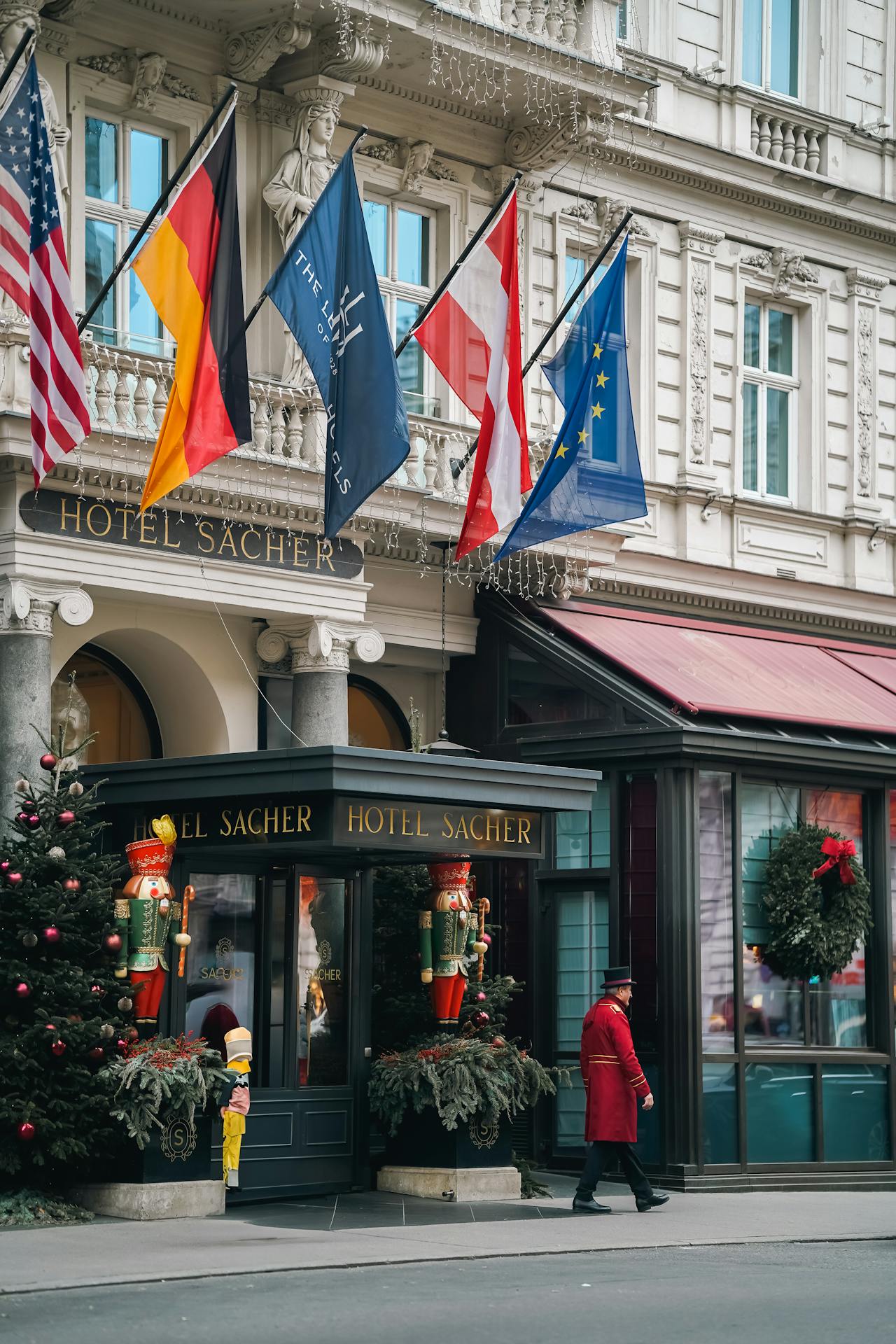
The Hotel Sacher is such an institution in Vienna that it even has a distinctive slice of chocolate cake named after it: Sacher Torte. If you have to ask how much it costs to stay here, then you can't afford it. It's that kind of place.
🎡 2nd District — Leopoldstadt
Best for: Families (proximity to the Prater); travellers interested in Vienna beyond the imperial monuments; those wanting value closer to the centre.
Price: Meaningfully cheaper than the 1st. U1 and U2 give fast access across the Danube Canal to the centre.
Character: One of Vienna's most interesting and underrated neighbourhoods. Historically the centre of Vienna's Jewish community. Excellent food and café scene. Contains the Karmelitermarkt, one of the city's best neighbourhood markets, and the Augarten baroque park.
U-Bahn & Transport: Praterstern (U1, U2) is the district's main hub and a major interchange U1 gets you to Stephansplatz in two stops (four minutes). Schwedenplatz (U1, U4), on the Danube Canal boundary with the 1st district, is effectively walking distance from much of Leopoldstadt and connects you directly onto the Ring. Taborstrasse (U2) and Nestroyplatz (U1) serve the residential interior. Wien Praterstern is also a regional rail station with S-Bahn connections, making it useful if you're arriving from further afield.
The star attraction: The Prater is Vienna's vast public park (free to enter) and contains the Riesenrad, the 65-metre Giant Ferris Wheel that has dominated the Vienna skyline since 1897. It is one of the oldest working Ferris wheels in the world and the views from the top are genuinely spectacular. Beyond it, the Prater stretches for miles of woodland, cycling paths, and the famous 4.5km Hauptallee chestnut avenue. The Augarten, a formal baroque park in the north of the district, contains two enormous WWII anti-aircraft towers still standing, too large and too solidly built to demolish. The Karmelitermarkt is one of Vienna's best neighbourhood food markets, with good coffee stands and weekend produce stalls.
Why tourists stay here: Leopoldstadt gives you genuine proximity to the centre at a substantially lower price, plus access to the Prater and a neighbourhood with real character and excellent food options. It is the obvious choice for families as the Prater is free, the tram connections are fast, and there is nothing threatening about walking the streets at any time. The 2nd has an intellectual and cultural texture that the purely imperial 1st lacks.
→ Check Hotels in Leopoldstadt (2nd District)🌿 4th District — Wieden
Best for: Those wanting a quiet, residential base near the Naschmarkt and Karlsplatz with fast access to both the centre and Schönbrunn.
Price: Mid-range, good value for the location.
Character: Solidly residential Gründerzeit apartment buildings, good local restaurants, the Karlskirche baroque church. U1 and U4 at Karlsplatz.
U-Bahn & Transport: Karlsplatz (U1, U2, U4) is on the northern edge of Wieden, one of Vienna's most important interchanges, with three lines converging. U1 north gets you to Stephansplatz in one stop; U4 west runs directly to Scho¶nbrunn Palace in ten minutes. Kettenbruckengasse (U4) places you at the southern end of the Naschmarkt. The Taubstummengasse (U1) station is in the quieter southern part of the district. Tram 1 and tram D run along the Ringstrasse for those who prefer surface transport. The district is also easy cycling distance to the centre along flat streets.
The star attraction: The Karlskirche Church of St Charles Borromeo is one of the finest baroque buildings in Central Europe, completed in 1737 and rising to 72 metres. A panoramic lift inside the church takes you up into the painted dome ceiling for close-up views. It faces the Resselpark pond and the Kunsthistorisches Museum is a ten-minute walk along the Ring. More practically, the Naschmarkt Vienna's principal food market stretching 1.5km along the Wienzeile opens Tuesday to Saturday and is the best place in the city to eat breakfast standing up, buy cheese, or watch Vienna go about its morning. The Belvedere Palace complex (home to Klimt's The Kiss) is a 15-minute walk east through residential streets.
Why tourists stay here: Wieden earns its place as a recommended base by combining outstanding transport connections with a calmer, more residential feel than the 1st. You are never more than one U-Bahn stop from the historic centre and one U4 ride from Schonbrunn. The Naschmarkt makes mornings genuinely pleasurable. And because Wieden is not marketed as a tourist district, hotel prices reflect its local status rather than its tourist convenience.
→ Find Hotels in Wieden (4th District)🎨 6th and 7th Districts — Mariahilf and Neubau
Best for: Visitors whose interests lean toward contemporary culture, food, design, and shopping rather than purely imperial Vienna.
Price: Mid-range, numerous options.
Character: The 7th (Neubau) is Vienna's most creative neighbourhood — independent boutiques, some of the city's best new restaurants, and the MuseumsQuartier on its edge. The 6th contains the Mariahilfer Strasse shopping boulevard, arguably Vienna's leading shopping area.
U-Bahn & Transport: Coverage here is excellent across two lines. Neubaugasse (U3) and Zieglergasse (U3) run through the heart of the 7th. MuseumsQuartier (U2) stations you directly at the entrance to the museum complex on the border of the 7th and 1st districts. Volkstheater (U3) serves the north-eastern edge. In the 6th, Westbahnhof (U3, U6) is a major regional rail terminus serving trains to Salzburg, Germany, and beyond; a significant practical advantage if you are travelling onward by rail. U6 runs along Mariahilfer Strasse. Tram 49 connects Neubau with the Ring.
The star attraction: The MuseumsQuartier on the 7th District's eastern edge is one of the largest museum complexes in the world, the Leopold Museum (the definitive Egon Schiele collection), the Museum of Modern Art (mumok), the Kunsthalle Wien, and several smaller institutions are all within a single courtyard complex. The Kunsthistorisches Museum and the Naturhistorisches Museum, facing each other across Maria-Theresien-Platz, are a ten-minute walk. Within Neubau itself, the Spittelberg quarter cobbled streets, 18th-century houses, independent wine bars, it offers some of the most pleasant early-evening wandering in the city.
Why tourists stay here: The 6th and 7th represent the most liveable combination of character and convenience in Vienna. Neubau has the city's best concentration of independent restaurants, wine bars, and design shops. You are not living among other tourists, you are staying in a proper neighbourhood that Viennese people actually choose to live in. The museum access is superb, the U3 connects you to the 1st district in under ten minutes, and Westbahnhof puts onward rail travel within walking distance of your hotel.
→ See availability in Mariahilf (6th District)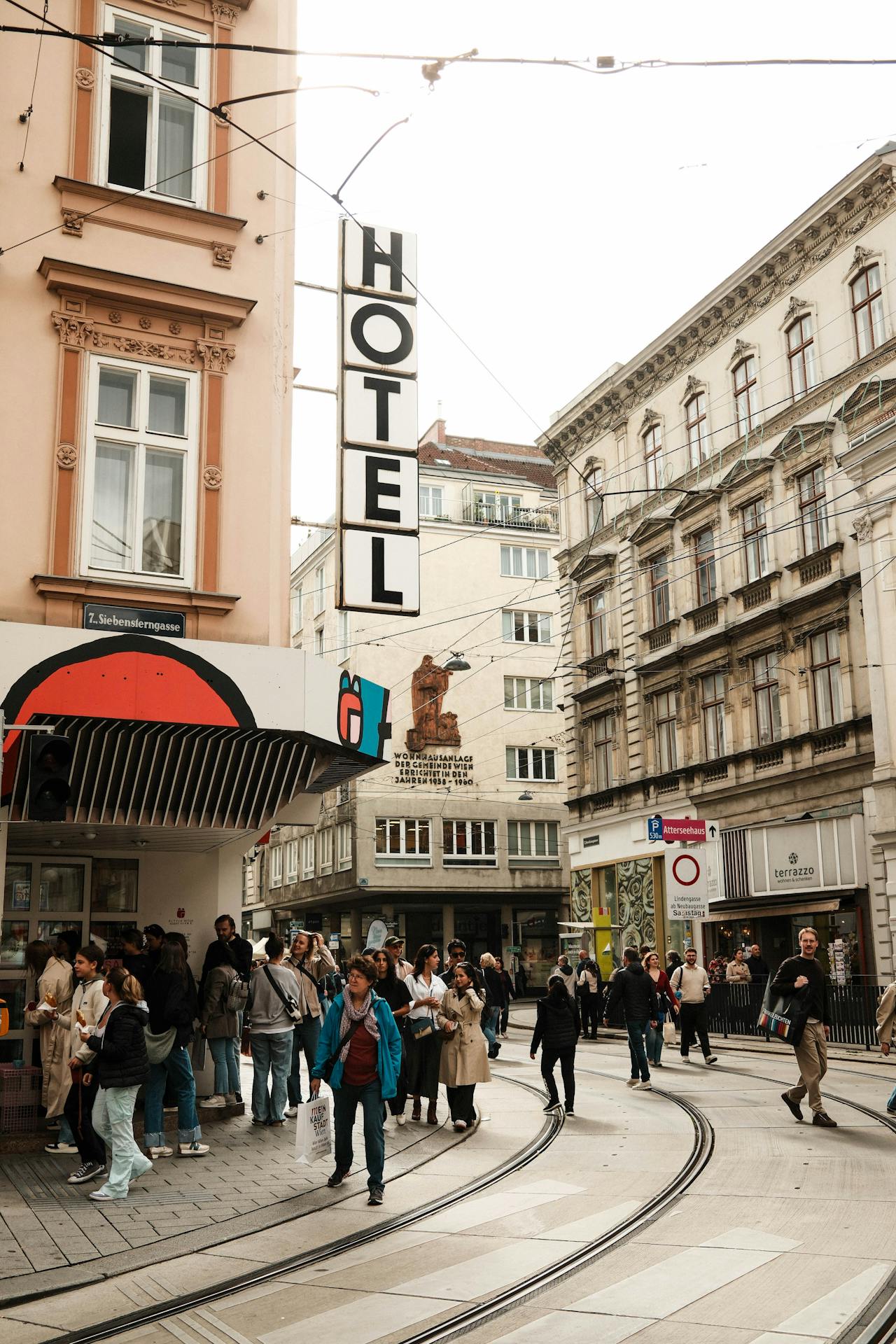
Hotels further away from the first district are often sited next to a main street. Some have noisy trams rattling by for 20 hours a day. Check a streetview map to see if a hotel you're eyeing will give you a decent night's sleep. Note the street sign in the middle-left of the photo - the number tells you which district the street is in.
📚 8th and 9th Districts — Josefstadt and Alsergrund
Best for: Value seekers who want genuine inner-city character without tourist pricing.
Price: Best value in the inner ring for equivalent quality.
Character: The 8th is quiet, residential, full of independent theatres and excellent local restaurants. The 9th is home to the University of Vienna and has a livelier student-influenced café and bar culture.
U-Bahn & Transport: Rathaus (U2) in the 8th puts you two stops from the Ringstrasse and Volkstheater. Schottentor (U2) on the border of the 9th and 1st districts is one stop from the Ring and connects you to the university, the Ringstrasse and onward to the airport via the CAT at Wien Mitte. Josefstadter Strasse (U6) serves the 8th directly. In the 9th, Alser Strasse and Michelbeuern-AKH (both U6) provide coverage in the upper district. Tram D runs down Wahringer Strasse through the 9th, connecting it efficiently to the Ringstrasse. Both districts are also highly walkable to the Ring, the 9th's southern edge is barely ten minutes on foot from the Burgtheater.
The star attraction: The Rathaus (City Hall), a vast neo-Gothic building facing the Ringstrasse, dominates the 8th District boundary, its forecourt hosts Vienna's famous Christmas market and Summer film festival. The Votivkirche in the 9th is a dramatic neo-Gothic church commissioned by Emperor Franz Joseph I to give thanks after surviving an assassination attempt in 1853. More unusually, the Sigmund Freud Museum at Berggasse 19 in the 9th is Freud's actual apartment and consulting rooms, preserved largely as they were when he fled Vienna in 1938. For those with any interest in the history of psychoanalysis, it is compelling and not overrun.
Why tourists stay here: These two districts represent the best-value base in inner Vienna. The 8th is genuinely quiet, independent theatres, local restaurants with no English menus outside, streets that feel like the real city rather than a stage set for visitors. The 9th has a livelier, student-influenced café and bar scene around the university. Neither district is tourist-facing, which means hotel prices are set for the people who actually live here. The U-Bahn and tram connections are fully adequate for daily sightseeing, and you are likely to feel more oriented, more locally embedded than you would in the 1st.
→ Find Hotels in Josefstadt (8th District)One Thing Most Guides Omit
Vienna's older hotels — and many of the most characterful ones are old — were built when guests arrived with trunks rather than roller bags and when "accessible" meant something entirely different. Lifts are often retrofitted into buildings that were not designed for them, serving alternate floors or requiring a key to operate. Rooms on upper floors in historic buildings can mean four or five flights of stairs. Check the hotel's specific lift situation when booking if this affects your travel. Vienna's newer hotels and the international chains have none of these quirks. The choice between character and convenience is genuinely yours to make — but make it consciously rather than discovering the situation on arrival at 11pm with a 20kg suitcase.
A Word About Spare-room Platforms
Vienna is an orderly and well‑run city, and you’ll find both hotels and short‑term apartment rentals available. While some travellers enjoy the extra space of a private rental, the experience can vary depending on the host and the building - standards vary. For short stays, I usually recommend hotels because they offer 24‑hour reception, proper security, and immediate assistance if you arrive late or something doesn’t go to plan. Vienna’s hotels are well‑regulated and professionally managed, which makes them a more reliable choice — especially if you’re unfamiliar with the city or travelling during busy seasons.
The link below is an affiliate link. If you make a purchase through them, we may earn a small commission at no extra cost to you.
You’ve found the right area — now lock in the right hotel before it's gone!
Vienna hotels fill up all year round and prices climb sharply in peak season. Klook offers deals on properties across the areas we recommend with instant confirmation. Take 30 seconds to compare availability and avoid overpaying or ending up with a poor-quality room.
Check Hotel Deals on Klook →Live availability & deals checked in real time • The map on their page top-left is handy • Tick the "under 3km from city center" to see well-located hotels