
Vienna Sightseeing — What Nobody Tells You
Vienna's principal attractions are, almost without exception, extraordinary. There is very little of the gap between reputation and reality that disappoints in other famous cities — no "is that it?" moment at the end of a long queue. Schönbrunn delivers. The Kunsthistorisches Museum delivers. The Belvedere delivers. The Vienna State Opera delivers so thoroughly that an evening there can recalibrate your entire relationship with live music. The city's most famous things are famous for the right reasons.
What the city does have in abundance, however, is the capacity to be experienced badly — rushed, poorly timed, over-ticketed, and exhausted by mid-afternoon. This page addresses the how alongside the what.
Click any attraction in the list or tap a marker on the map for opening hours, entry costs, nearest U-Bahn, and insider tips. Filter by category to plan your day.
Use the tabs below to switch between the list and map.
🏰 Schönbrunn Palace — Allow Half a Day Minimum
The former summer residence of the Habsburg imperial family: 1,441 rooms, formal French-style gardens stretching up to a hilltop colonnade with views across the entire city, the world's oldest zoo in its grounds, and interior rooms of a Baroque extravagance that takes a moment to process. The Grand Tour (40 rooms) is worth the extra over the Classic Tour — you get Napoleon's bedroom, the rooms where the young Mozart performed, and the Hall of Mirrors where the empire's fate was debated. Take the audio guide; it's genuinely good.
Book online. Queue times at the ticket desk in summer can run to 45 minutes. Arrive when the palace opens at 9am and do the interior first, before the afternoon coaches. The gardens are free and open from early morning. The view from the Gloriette colonnade at the top of the hill — across the formal gardens to the palace and the city beyond — is one of the finest panoramas in Europe and costs nothing except the walk uphill.
Entry: Grand Tour ~€35, Classic Tour ~€28. Open daily from 9am. Book at schoenbrunn.at.
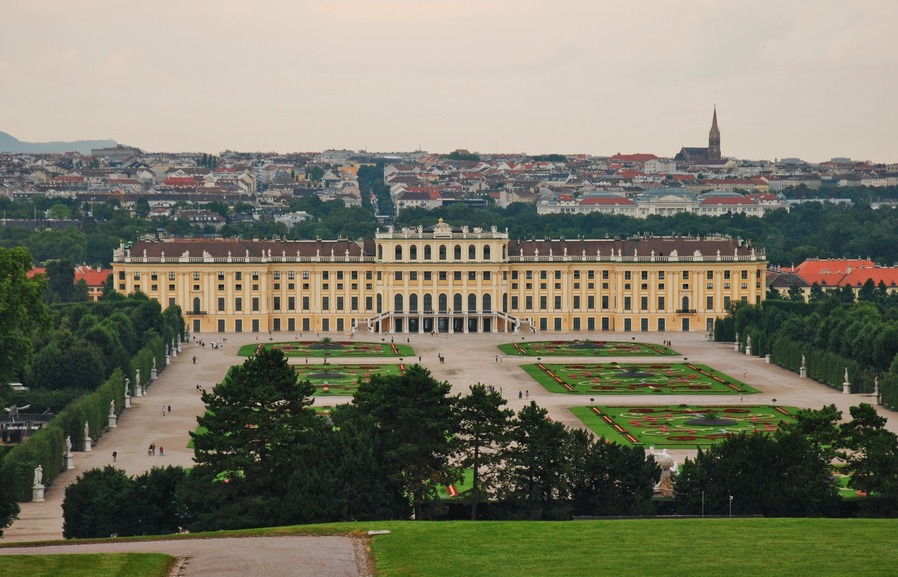
Schönbrunn became Imperial land in 1569 and has been home to the world's first zoo since 1752. The Habsburg dynasty lived here for 350 years.
🎨 The Belvedere — Allow Three to Four Hours
Two Baroque palaces facing each other across formal gardens in the 3rd district. The Upper Belvedere holds the finest collection of Austrian art in the world, centred on Gustav Klimt. His painting The Kiss — two figures entwined in gold leaf, one of the most reproduced images in Western art — is here, in person. The reproduction does not prepare you for the original. The gold leaf catches the light in a way print simply cannot capture. People stop in front of it. Allow time.
The same collection holds Egon Schiele's raw, unsettling portraits and Oskar Kokoschka's expressionist masterworks. The reflective pool in front of the Upper Palace is one of Vienna's finest photographs. If the Klimt rooms are crowded — on summer afternoons they often are — start in the quieter Lower Belvedere and the Orangery, and work your way up.
Entry: Adults ~€18–25 depending on exhibition. Book online in summer. Under 19: free.
👑 The Hofburg — Allow Two to Three Hours
The Habsburg winter palace is not so much a building as a small city — expanded by successive emperors for seven centuries until it now occupies an entire district. Inside: the Imperial Apartments, the Sisi Museum, the Imperial Silver Collection (140-metre-long dining tables' worth of gold plate, porcelain and vermeil, all used — not displayed behind glass but actually laid for dinner), the Spanish Riding School, and the Austrian National Library's State Hall, which is arguably the most beautiful room in the world. The Imperial Apartments and Sisi Museum are ticketed together. The contrast between Franz Joseph's deliberately spartan military desk and Sisi's obsessive gymnasium equipment in adjacent rooms tells you everything about the marriage.
The Hofburg's courtyard opens onto Heldenplatz — the enormous square in front of the Neue Burg wing. Stand there, keep your eyes above street level, and do a slow 360°. The panorama is almost entirely unchanged since the late 19th century. It's one of the easiest time-travel moments in Europe.
The Hofburg's courtyard also carries history of a darker kind: the balcony from which Hitler addressed a crowd of 200,000 in 1938 is still there. Vienna does not hide from this.
Entry: Imperial Apartments + Sisi Museum ~€18 adults. Spanish Riding School performances sell out months ahead — book at srs.at. Morning training sessions are open to visitors at reduced cost.
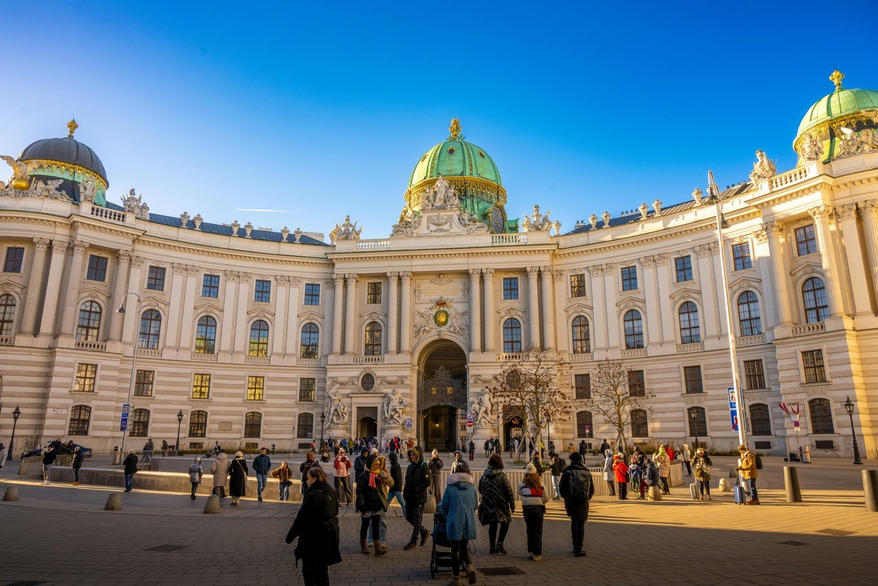
Part tourist attraction, part government headquarters — the Hofburg is still the administrative heart of Austria. The country's president has his offices here.
⛪ St Stephen's Cathedral — Allow One to Two Hours
The Stephansdom is free to enter. The interior is Gothic, immense, and carries seven centuries of accumulated devotion. Most visitors look up at the famous chevron-patterned roof and call it done. Don't. The catacombs beneath — where 11,000 plague victims' bones are stacked in eerie bone houses, and copper urns hold the internal organs of Habsburg emperors (the bodies went to the Kaisergruft, the hearts to the Augustinerkirche; the Habsburgs distributed themselves across the city in death as they had governed it in life) — are accessed by guided tour and are among the most memorable things you'll see in Vienna. Tours run roughly every 30 minutes.
The cathedral is at its most atmospheric at Mass — held daily, tourists welcome. Check the schedule on the cathedral website before visiting.
Entry: Nave free. Catacombs guided tour ~€6. South Tower climb ~€6 (343 steps, no lift). North Tower lift ~€6.
🖼️ The Kunsthistorisches Museum — Allow Half a Day
One of the great art museums of the world, consistently undervisited relative to its quality — because it is not the Louvre, not the Uffizi, not the Prado. On a weekday morning in shoulder season, you can stand in front of Vermeer, Bruegel, Raphael, Caravaggio, and Titian with real space around you. The building itself is imperial Vienna's architecture at its most deliberate, and the staircase — painted in trompe l'oeil by, among others, a 26-year-old Gustav Klimt — is worth significant time before you reach a single painting.
But the section most visitors walk straight past is the Kunstkammer — the Habsburg cabinet of curiosities. Centuries of emperors hoarding the world's most extraordinary objects. Benvenuto Cellini's gold salt cellar, arguably the finest Renaissance decorative object in existence. A 16th-century mechanical galleon that once sailed across dinner tables firing miniature cannons. Biblical scenes carved into walrus ivory the size of a credit card. Giambologna bronzes. It takes your breath away, and most people miss it entirely.
Entry: Adults ~€21. Audio guide included and unusually good. Thursdays open until 9pm — the quietest time to visit.
⚰️ The Kaisergruft — Habsburgs in the Basement
Beneath the Kapuzinerkirche on Neuer Markt lies the Imperial Crypt — final resting place of 149 Habsburgs across four centuries, including Franz Joseph, Empress Sisi, and their son Rudolf, the tragic figure of the Mayerling affair, all buried within metres of each other. The sarcophagi range from plain 17th-century iron boxes to the absurdly ornate double-coffin of Maria Theresa and her husband, covered in cherubs, skulls, battle scenes and crowns. It is simultaneously theatrical and deeply human.
Entry is cheap and visitor numbers are far lighter than the Hofburg. It is one of Vienna's most underrated experiences.
Entry: Adults ~€8. Open daily. Located on Tegetthoffstraße, a five-minute walk from the Opera House.
🎖️ The Military History Museum — One of Europe's Most Significant Rooms
This is one of the most historically important rooms in Europe, and almost nobody seems to talk about it. The Heeresgeschichtliches Museum holds the open-top touring car Archduke Franz Ferdinand was riding in when he was shot in Sarajevo on 28 June 1914 — the assassination that triggered the First World War. The bullet holes are still in the bodywork. A display case beside the car holds the clothes he was wearing that day. The bloodstains are still visible.
A direct, physical connection to the moment that changed the 20th century — for a few euros, with almost no queue, in a spectacular neo-Byzantine palace in the Arsenal complex that most visitors have never heard of. The building itself, with its painted ceilings and room-length armoury halls, is worth coming for alone.
Entry: Adults ~€8. Located in the Arsenal complex in the 3rd district — 10 minutes by tram from the centre. Hauptbanhhof is nearest U-Bahn station, then a short walk south.
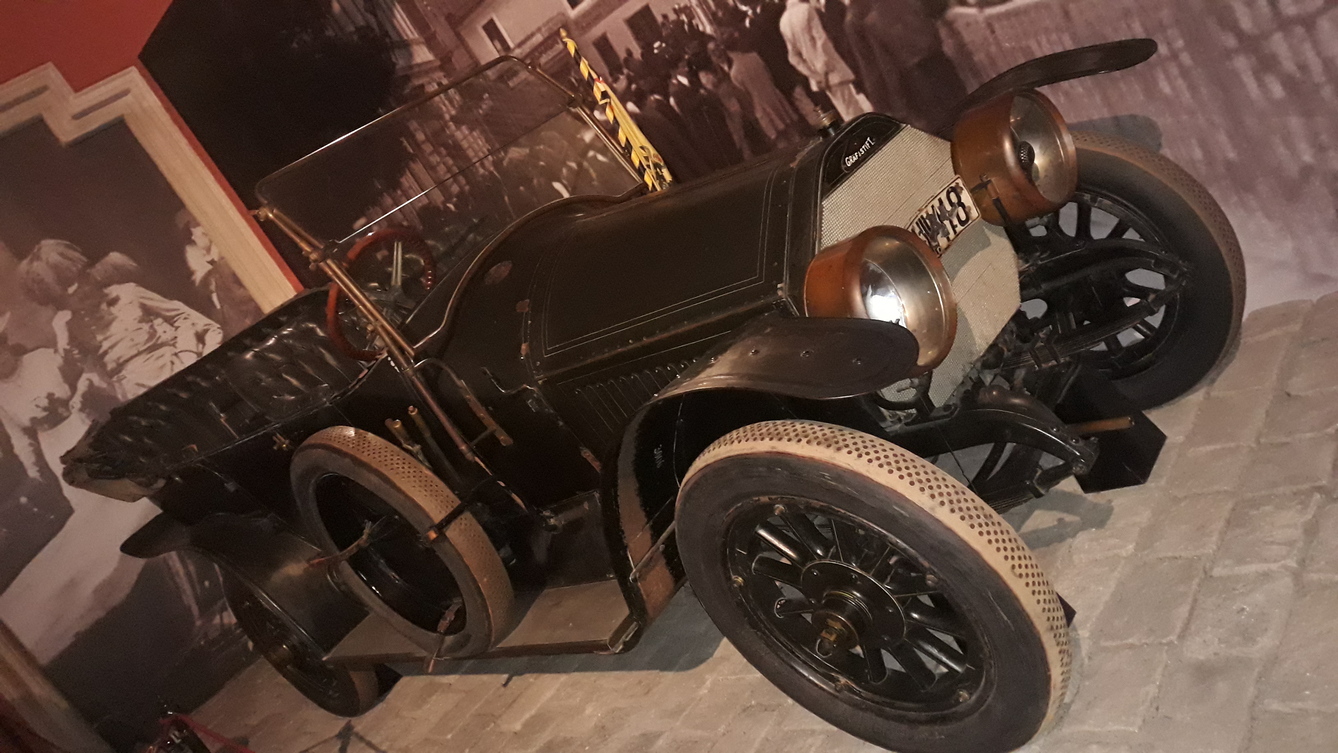
This is the Rolls Royce that Archduke Franz Ferdinand was assasinated in, sparking World War 1. This museum probably has the best World War 1 displays of any comparable museum in the world. All the other displays are good too.
🎵 Mozarthaus Vienna — Where Figaro Was Written
Mozart lived in Vienna for the last decade of his life and moved constantly — he had 13 addresses in the city. This apartment on Domgasse, steps from Stephansdom, is the only one that survives. He lived here from 1784 to 1787 and composed The Marriage of Figaro in these rooms. The apartment has been carefully restored — no waxwork dioramas, no theatrical overreach — and gives an honest, intimate sense of how he actually lived and worked.
Vienna takes its composers seriously. Beethoven, Haydn, Brahms, Schubert, Strauss — all have their trails and their memorial rooms. But the Mozarthaus is the most compelling of them.
Entry: Adults ~€12. Located on Domgasse 5, five minutes' walk from Stephansdom.
Art, Architecture & The Unexpected
🌿 Hundertwasserhaus — and the Better Alternative Next Door
The Hundertwasserhaus on Löwengasse is an apartment block designed by the artist Friedensreich Hundertwasser in the 1980s — a deliberately irregular, colourful building where no two windows are alike, trees grow out of the walls, and straight lines are treated as a moral failing. It is genuinely arresting. The colours, the curves, the murals, the rooftop forest: it looks like a building imagined by a child and executed by a master craftsman, which is more or less what happened. Still home to real residents, so you cannot enter.
The souvenir market surrounding it has grown large and loud. The best way to see the building is to arrive early — before 9am in summer — walk the full perimeter, and leave before the tour groups arrive.
For the fuller Hundertwasser experience, the Kunst Haus Wien a few minutes' walk away is the better destination. It's a Hundertwasser-designed building you can actually enter, housing a large permanent collection of his paintings, prints, and architectural visions — including his radical ecological building concepts, which look less fantastical now than they did in 1972. Far fewer visitors, real depth, and a mosaic-tiled café accessible without a museum ticket.
Hundertwasserhaus entry: Free (exterior only). Kunst Haus Wien entry: Adults ~€12. Both in the 3rd district, 10 minutes by tram from the centre.
🕍 Karlskirche — Climb Inside the Ceiling
The Baroque Karlskirche on Karlsplatz is one of Vienna's finest churches — twin triumphal columns flanking a copper dome, built by Charles VI in 1713 as a vow after the great plague. The exterior is familiar from every Vienna postcard. What most visitors don't know is what happens inside.
A panorama lift runs up through a scaffold structure inside the dome, taking you to eye level with Johann Michael Rottmayr's enormous ceiling frescoes, painted in the 1720s. At the top, you are within arm's reach of painted figures that most visitors have only ever seen from 50 metres below. The scale, the detail, and the slightly vertiginous sensation of being suspended inside a Baroque heaven are genuinely unforgettable. The ticket is modest. The crowds are thin. This is one of Vienna's best-kept secrets.
Entry: Adults ~€8, includes panorama lift. On Karlsplatz, U1/U2/U4 Karlsplatz.
🎻 The Vienna State Opera — Even Without a Ticket
The Staatsoper is one of the world's great opera houses, and performances sell out far in advance. But there are two options most visitors don't know about. Standing tickets (Stehplätze) go on sale 80 minutes before each performance for €3–10. The regulars tie scarves to the railings to hold their spot — queue culture here is serious, arrive at least an hour before sale time for major productions. The acoustic in the standing section is outstanding. You have heard nothing like it.
Alternatively, guided tours of the building run daily, are inexpensive, and give access to the red-and-gold auditorium, the grand foyer, and the tea salon. If a performance is out of reach, the tour is a genuine substitute.
Entry: Standing tickets €3–10, available 80 min before curtain. Building tours ~€9 adults. Check spielplan.wiener-staatsoper.at for the programme.
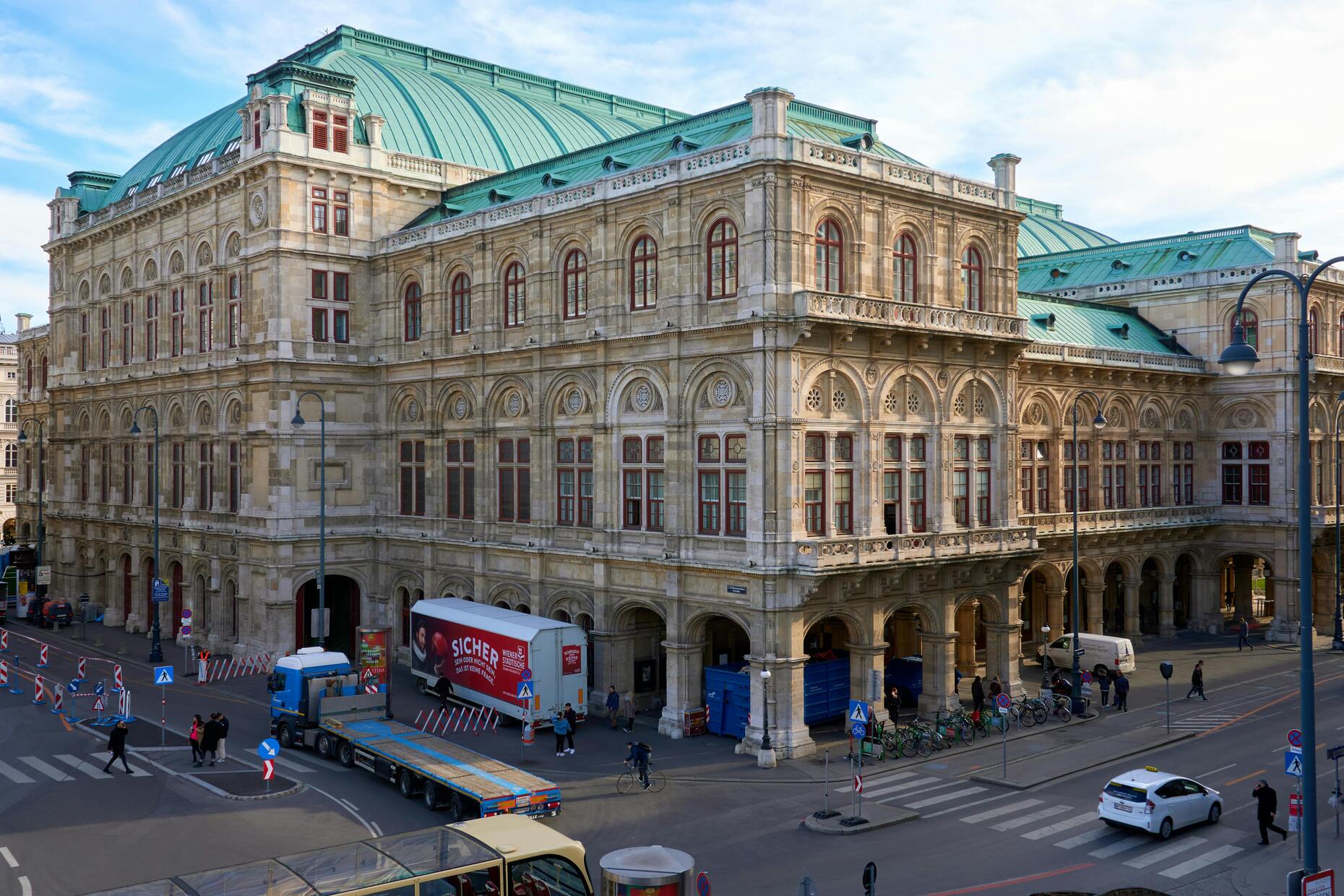
You don't need to be into opera to appreciate everything that is involved in delivering a performance.
🚋 The Ringstraße — Allow Two Hours
Vienna's grand boulevard — built by Emperor Franz Joseph in the 1860s to replace the medieval city walls — is itself an attraction. The Opera House, the twin art history and natural history museums, the Parliament, the City Hall, the Burgtheater, the Volksoper: all built within a single generation, a deliberate act of imperial urbanism designed to project Vienna as the cultural capital of Europe. The buildings were styled in different historical idioms — Gothic for the City Hall, Greek for the Parliament, Renaissance for the museums — as a kind of architectural manifesto of civilisation.
Tram D runs the full length of the Ring on the same ticket as every other tram. Take it at least once, ideally in the early morning or at dusk when the light is good and the buildings are lit. Walking or cycling the full circuit takes about 90 minutes at a comfortable pace, and costs nothing.
Cost: The price of a transport ticket, or free on foot.
Food, Markets & Everyday Vienna
🛒 The Naschmarkt — Vienna's Living Market
Vienna's famous open-air market runs for nearly two kilometres along the Wienzeile between the 4th and 6th districts. During the week it is a working market — Austrian farmers, Turkish spice merchants, olive and pickle specialists, fresh fish counters, Balkan butchers, and cheese producers from across Central Europe. On Saturday mornings a flea market takes over the far end, selling everything from genuine antiques and first-edition books to outright junk. Either way it is a vivid, loud, authentically Viennese experience that most packaged city tours never get near.
The tourist-facing sit-down restaurants at both ends of the market are fine but overpriced. The best-value eating in Vienna is at the Balkan and Turkish snack counters mid-market — grilled sausage, burek, falafel, freshly baked flatbread — for a few euros standing up. Walk well into the market before you stop.
Entry: Free. Open Monday–Saturday. Bring cash for smaller stalls. Nearest U-Bahn: Kettenbrückengasse (U4).
☕ The Viennese Coffee House — A UNESCO-Listed Institution
Vienna's coffee-house culture is listed by UNESCO as Intangible Cultural Heritage, which is a dignified way of saying that sitting in a café here is not a break from experiencing the city — it is the experience. The traditional Viennese coffeehouse was where writers wrote, revolutionaries plotted, and philosophers argued in public. Freud, Trotsky, Herzl, Stefan Zweig, and Adolf Loos all had their regulars. The institution produced extraordinary art, literature, and ideas across 150 years, fuelled by coffee and the unspoken rule that nobody would rush you.
That rule still applies. Order a coffee, and a glass of water arrives with it. No one will check on you. No one will bring a bill you didn't ask for. Stay an hour, read a newspaper, write in a notebook. This is encouraged.
Café Central has mind-blowing interiors — a vaulted Gothic arcade that genuinely looks like a palace — but it is currently closed and not expected to reopen until late Autumn 2026. Café Schwarzenberg on the Ringstraße has comparable period atmosphere and considerably fewer visitors. Café Hawelka in the first district is scruffy, small, and beloved — barely changed since the 1950s, and still run by the founding family. Café Sperl in the 6th district is a quieter, neighbourhood version used by actual Viennese rather than tourists, with excellent Apfelstrudel and billiard tables at the back.
Order a Melange — half espresso, half steamed milk, the classic Viennese coffee. Not a cappuccino. Not a latte. A Melange.
Cost: A Melange typically €4–6. There are no extra charges for sitting as long as you like.
Café Central is arguably Vienna's most famous coffee house — currently closed and expected to reopen late Autumn 2026. Café Schwarzenberg and Café Sperl are excellent alternatives in the meantime.
🏛️ MuseumsQuartier — Allow Half a Day
The MuseumsQuartier — MQ, as it's universally known — is one of the world's ten largest cultural complexes, built inside and around the former Imperial Court Stables. The contrast between the Baroque outer walls and the stark modernist Leopold Museum and MUMOK (Museum of Modern Art) buildings inside is deliberate, and initially startling. It works.
The Leopold Museum holds the world's largest Egon Schiele collection — the raw, sexually confrontational self-portraits and figure studies that caused scandal in his lifetime and made him one of the most important artists of the early 20th century. Schiele died in 1918 at 28, three days after his pregnant wife, both killed by the same flu epidemic. The collection is extraordinary. There is also a significant Klimt holding here that complements the Belvedere's without duplicating it.
MUMOK, next door, covers Pop Art, Fluxus, Nouveau Réalisme, and Viennese Actionism — a 1960s movement so provocative that the Austrian government briefly tried to imprison its practitioners. The permanent collection is patchy in places, but the temporary exhibitions are often among the best contemporary art shows in central Europe.
The courtyard between the museums is itself a destination. In summer, giant foam deck chairs (the Enzis) are arranged across the space and the courtyard becomes a meeting point for young Viennese in the evenings — free to use, open late, and one of the most relaxed public spaces in any European capital.
Entry: Leopold Museum ~€16 adults. MUMOK ~€12 adults. Combined tickets available. Free entry to courtyard and many outdoor areas. Museumsplatz 1, U2 MuseumsQuartier.
🎡 The Prater & the Riesenrad — Allow Two Hours
Vienna's vast public parkland contains kilometre after kilometre of flat, tree-lined cycling and walking paths — forest in the middle of a capital city, free to use. Hire a bike from any of the city's Citybike stations and you can cover it properly in an hour or two.
At the park's edge sits the Riesenrad — the giant 1897 Ferris wheel made famous by Orson Welles in The Third Man. It is slow, it creaks in the wind, and the gondolas are the originals from 1897. This is not a flaw. The wheel turns a full rotation in roughly 20 minutes and gives a proper, unhurried panoramic view over the city. Come at dusk. The gondolas hold up to 12 people and the view as the city lights come on is one of Vienna's best.
Entry: Riesenrad ~€14 adults. Prater park: free. Nearest U-Bahn: Praterstern (U1/U2).
The Essential Rule
Book ticketed attractions online in advance, particularly from June through August and throughout December. Vienna's major attractions are better managed than most comparable cities — queues are rarely the ordeal they can be in peak-season Florence or Paris. But "better managed" is not the same as "no queues." Book ahead, arrive at opening time, and start with the most popular sites while they're quiet. The city will reward the effort generously.