
Arriving in Vienna
Vienna International Airport — known officially as Flughafen Wien-Schwechat, coded VIE, and referred to by practically everyone simply as Schwechat after the nearby town — is a compact, well-organised airport that processes around 30 million passengers a year without the chaos that this number might suggest. It sits approximately 18 kilometres south-east of the city centre. Getting into Vienna from it is straightforward, inexpensive if you make the right choice, and expensive if you make the wrong one. The difference is explained below.
Before You Land — Entry Requirements
Austria is a member of the Schengen Area, which means entry requirements are set at the European Union level rather than nationally. Since October 2025, the EU's Entry/Exit System (EES) has been operational. This is an automated border registration system that records the entry and exit of non-EU, non-Schengen travellers at every Schengen border. You do not need to apply for anything in advance — the EES registers you automatically at the border. What it does mean is that your 90-day Schengen allowance is now tracked electronically rather than by passport stamps. If you have spent time elsewhere in the Schengen Area before arriving in Vienna, those days count toward your 90-day maximum. The system will know. Do not assume otherwise.
Citizens of the United States, Canada, Australia, the UK, and most other non-EU countries can enter Austria visa-free for up to 90 days in any 180-day period for tourism. Check the current entry requirements for your specific nationality at the Austrian Federal Ministry of the Interior website before travelling.
The Airport Itself
Vienna Airport has two main terminals — Terminal 1 for Schengen and domestic arrivals, Terminal 2 for non-Schengen long-haul — connected landside. Unlike Heathrow's five-terminal spread, navigating Vienna Airport does not require planning. It is manageable in scale, signage is clear and bilingual (German and English), and the walk from gate to passport control is rarely more than ten minutes.
Passport control for non-EU visitors has e-gates for eligible biometric passport holders — including US, UK, Canadian, and Australian citizens — and staffed desks for everyone else. Queue times are generally shorter than at comparable European hubs. Border officers are professional and direct. Have your accommodation address ready; they will sometimes ask.
After baggage reclaim you pass through customs on the standard green (nothing to declare) or red (goods to declare) system. The EU duty-free allowances apply: 200 cigarettes, one litre of spirits above 22%, four litres of still wine, and goods worth up to €430 purchased outside the EU. Anything above these limits goes through the red channel. Customs officers do conduct spot checks.
At the Airport — First Decisions
1.) Money. There are ATMs (cash machines) in the arrivals hall — use them in preference to the currency exchange desks, whose rates are considerably worse. Vienna operates extensively on card payment, but Euros are useful for smaller purchases, market stalls, and tipping. Withdraw €50–100 on arrival and replenish as needed from bank ATMs in the city rather than from street machines. Paying via your phone is slowly catching on, just ask the person serving you.
Better still, why not use a bank card with no foreign transaction fees and offer excellent rates with no markup? See how at the Vienna Practicalities page to Avoid being ripped off by your bank while you're in Austria.
2.) SIM card. Austrian mobile operators — A1, Magenta (T-Mobile), and Drei (3) — all have coverage throughout Vienna. A few airport SIM vending machines exist, but you will get a better deal buying from a phone shop in the city or downloading an eSIM before you travel. EU roaming rules no longer apply to UK travellers post-Brexit; check your home carrier's Austrian roaming rates before relying on your existing plan. Some foreign networks charge expensive daily rates and you'll be shocked when you get home to a surprisingly big bill.
You will almost certainly get a better deal buying a eSIM online before you travel and activating it on arrival. We have found the two best eSIMs for Vienna, why not see which one suits you?
Launch eSIM Comparison Page in a new tab3.) Vienna City Card. Available at the airport and from the WienMobil app. Combines unlimited travel on U-Bahn, trams, and buses with discounts at over 200 museums and attractions. A 24 hour card costs €19, a 48-hour card costs approximately €31; a 72-hour card approximately €37. For any visitor spending two or more full days in Vienna and visiting multiple paid attractions, it represents good value. Buy it before you leave the airport from the Tourist Info counter in the arrivals hall. Buy the card with the "Airport Transfer" option included if you plan to use the CAT or ÖBB trains to get to the city center.
Getting Into the City — Where the Money Goes
This is where most visitors either save money effortlessly or spend it unnecessarily. There are four good options, one middling option and one to avoid.
🚆 S-Bahn S7 — Best Value
The suburban S7 rail service runs between the airport and central Vienna, stopping at Wien Mitte (the most central), Praterstern, Floridsdorf, and other stations. The journey from the airport to Wien Mitte takes 23 minutes. A single ticket costs approximately €4.50. Trains run every 30 minutes, but only until 1.15am, resuming at 5am on weekdays, on weekends a longer gap after midnight. If you already have a Vienna transport pass, you pay only a small supplement (approximately €2.40) for the airport-to-city-border section. This is the option a Viennese person would use. You can buy your tickets from the red OBB ticket office in the arrivals hall, either at the staffed counter or from a machine. In front of this OBB office is a ramp that takes you down to the train platforms. At a display screen you'll find the correct platform for the next train into the city.
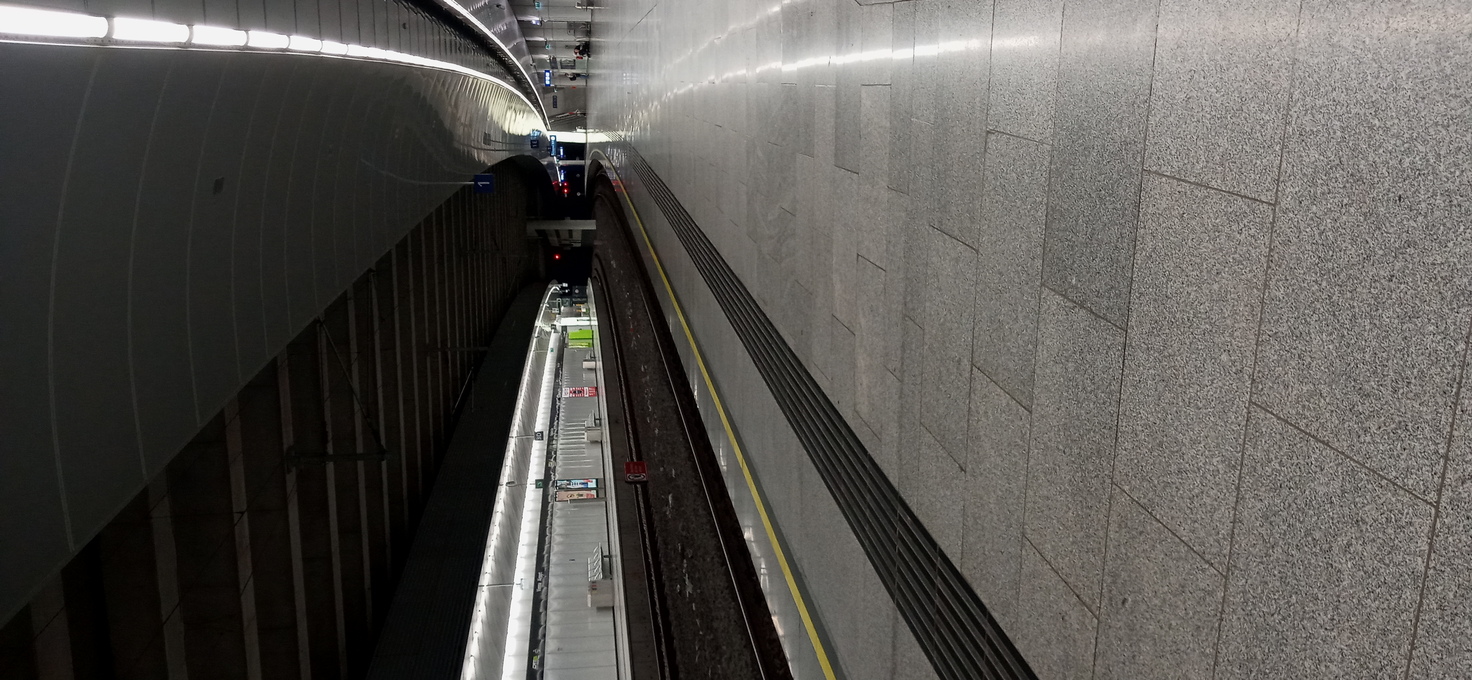
The platform for the S7 is shared with the CAT service - make sure you get on the correct train for your ticket. It's Europe, so trains run on the right-hand side of sets of tracks. Prepared Traveller tip: stand in the middle of the platform because sometimes the trains stop at the front, sometimes in the middle.
🚄 City Airport Train (CAT) — Premium Option
Non-stop between the airport and Wien Mitte in 16 minutes — seven minutes faster than the S7. A single ticket costs €11 online, €12 at the desk. Children under 15 travel free. It shares the same platform and tracks under the arrivals hall as the S7, so make sure you get on the correct train; it has its own livery with CAT written on the side. The genuine advantage: on departure, you can check luggage and collect your boarding pass at the Wien Mitte terminal in the city, then travel to the airport unburdened (City Check-In). Honest assessment: the CAT is a premium product for a seven-minute time saving. For most visitors the S7 is sufficient. If you have heavy luggage or want City Check-In on departure, it earns its price.
🚕 Vienna Airport Buses
Vienna Airport Bus (formerly Vienna Airport Lines/VAL) operates three coach routes between the airport and the city, offering a budget-friendly alternative to the CAT and S7 trains.
For most visitors, VAB 2 is the best option — it runs directly to Schwedenplatz/Morzinplatz in the heart of the city in around 20 minutes. VAB 1 serves Westbahnhof (approximately 40 minutes), while VAB 3 heads north to Donauzentrum, stopping at the Vienna International Centre and Messe Wien (approximately 42 minutes).
VAB 1 and VAB 2 run every 30 minutes; VAB 3 runs hourly. A single adult fare is €11, with a return ticket costing €20. Children under 6 travel free with an accompanying adult. They run through the night, even on weekends. The bus can be found right outside the main door to the airport at a stand that looks like a bus can fit in it. Its route will be displayed on the front of the bus. Tickets can be bought online in advance, from the driver as you board in cash, or at airport vending machines. You stow your luggage on the central rungs then find a seat. You need to know which stop you're getting off at, so visit the map on their website.
For routes, timetables, and booking, visit viennaairportbus.com.
🚕 Taxi or Pre-Booked Car
Approximately €35–45 to central Vienna. Journey time 20–30 minutes in normal traffic, longer at rush hour. Licensed airport taxis have fixed zone rates — confirm the price before you get in. For solo or duo travellers, the train is almost always cheaper and often faster at peak hours. The taxi stand is outside the main airport doors. They operate a queueing system, so you don't get to choose your taxi. It's metered from when you get in, so have your address you want ready.
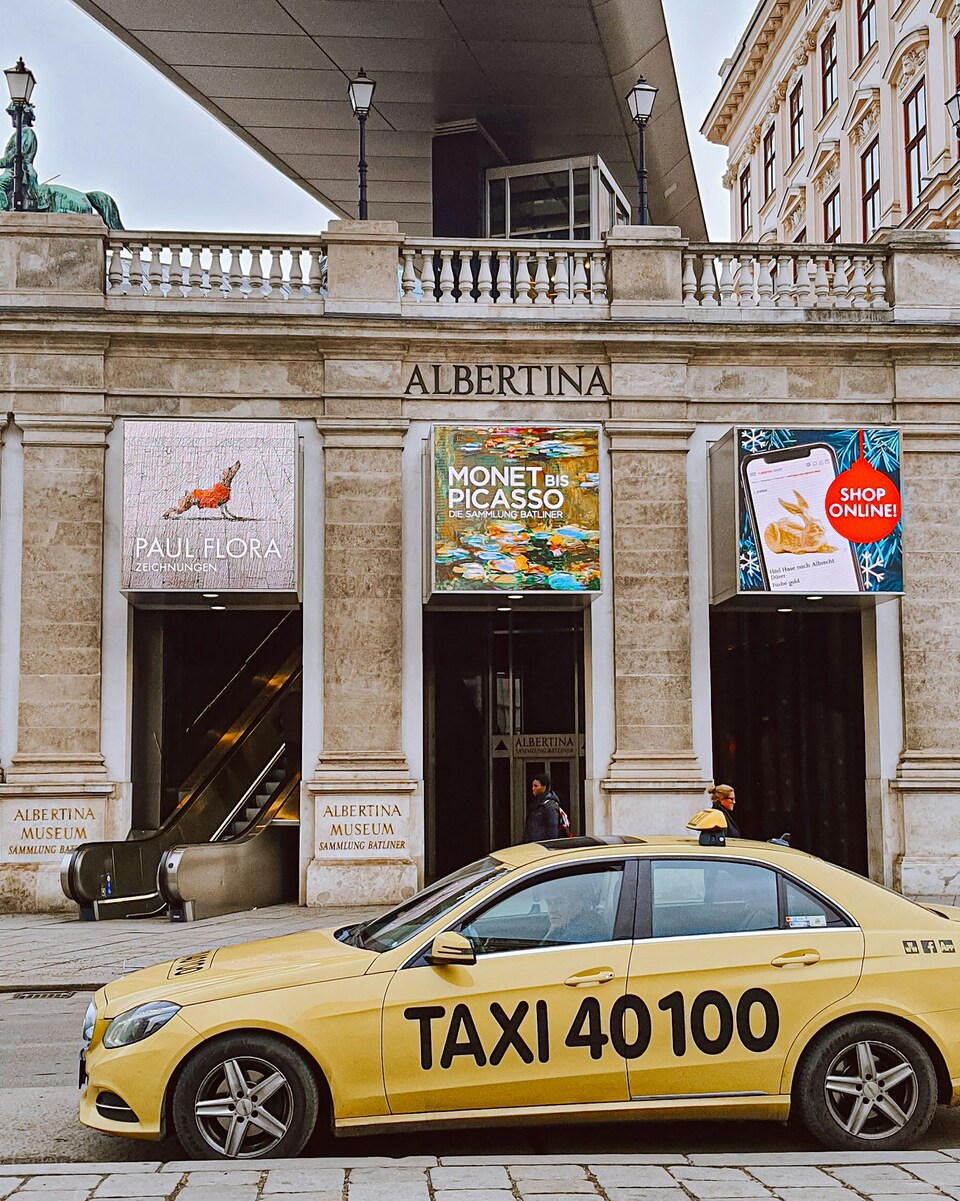
Taxis in Vienna are heavily regulated and policed. Despite this they maintain a new fleet, consequently you might consider their prices to be on the high side.
The middling option: 🚕 Uber & Bolt
Both Uber and Bolt operate at Vienna International Airport and are a convenient alternative to metered taxis — typically around 10% cheaper. You cannot hail either service from the kerb; you must book through their respective apps, after which the app will direct you to the designated rideshare pickup zone in the terminal.
Bolt is generally the slightly cheaper of the two and is growing in popularity, though Uber has the larger driver base and longer track record in Vienna. Both offer standard, XL (larger vehicle/more luggage), and pet-friendly options. If you're travelling with children, both services are more likely to have child seat options available than a standard taxi.
Fares are shown in the app before you confirm, so there are no surprises. For groups or those with bulky luggage, selecting the XL option is advisable.
Where and why it gets tricky: 1) Their drivers are not keen to take riders to the airport because they are not guaranteed a return ride, the city is more lucrative, thus your waiting time is longer than most other options. 2) Depending on a few factors such as time of day, they might actually cost more than a regular taxi waiting outside. 3) The designated pick-up point is further away than the regular taxi stand, which is not great in bad or cold weather.
Prefer a completely hassle-free arrival?
A pre-booked private transfer is the simplest way to get into Vienna. Your driver meets you in the arrivals hall (even if your flight is delayed), helps with your luggage, and takes you directly to your accommodation — no ticket machines, no navigation, no guesswork, no stress.
This makes the most sense after a long-haul flight, if you are arriving late at night, travelling with children or a mobility-impaired person, or carrying multiple large bags. Maybe you just want to arrive in Vienna in style? Pricing is usually comparable to a taxi, but with a fixed cost agreed in advance and no risk of bad traffic pushing the fare higher.
Check prices & availabilityThis is an affiliate link. If you book through it, we may earn a small commission at no extra cost to you.
A Few Things to Know Before You Leave the Terminal
Vienna's airport signs use the German word Ausgang for exit, Ankunft for arrivals, and Abflug for departures. The airport is signed in English throughout, so this is not practically critical — but knowing that Flughafen means airport and Hauptbahnhof means main railway station will serve you well on maps and transport boards throughout your visit. You might need this when you depart. Vienna meets you more than halfway on language. Meeting it a little in return makes the first impression of the city marginally warmer.