
Vienna Weather — When to Visit
Vienna has a proper continental climate, which means it does not hedge its bets. Summers are hot — genuinely, sometimes oppressively hot. Winters are cold — properly cold, with frost and occasional snow. Spring and autumn arrive sharply, stay briefly, and are both magnificent. The city does not offer the Mediterranean's forgiving year-round mildness, and it makes no apology for that. What it offers instead is four distinct seasons, each of which transforms the city in a different way, and each of which suits a different kind of visitor.
This is not London, where the weather is characterised primarily by its refusal to commit. Vienna's weather commits. That makes planning easier, and it makes the choice of when to go more consequential and predictable.
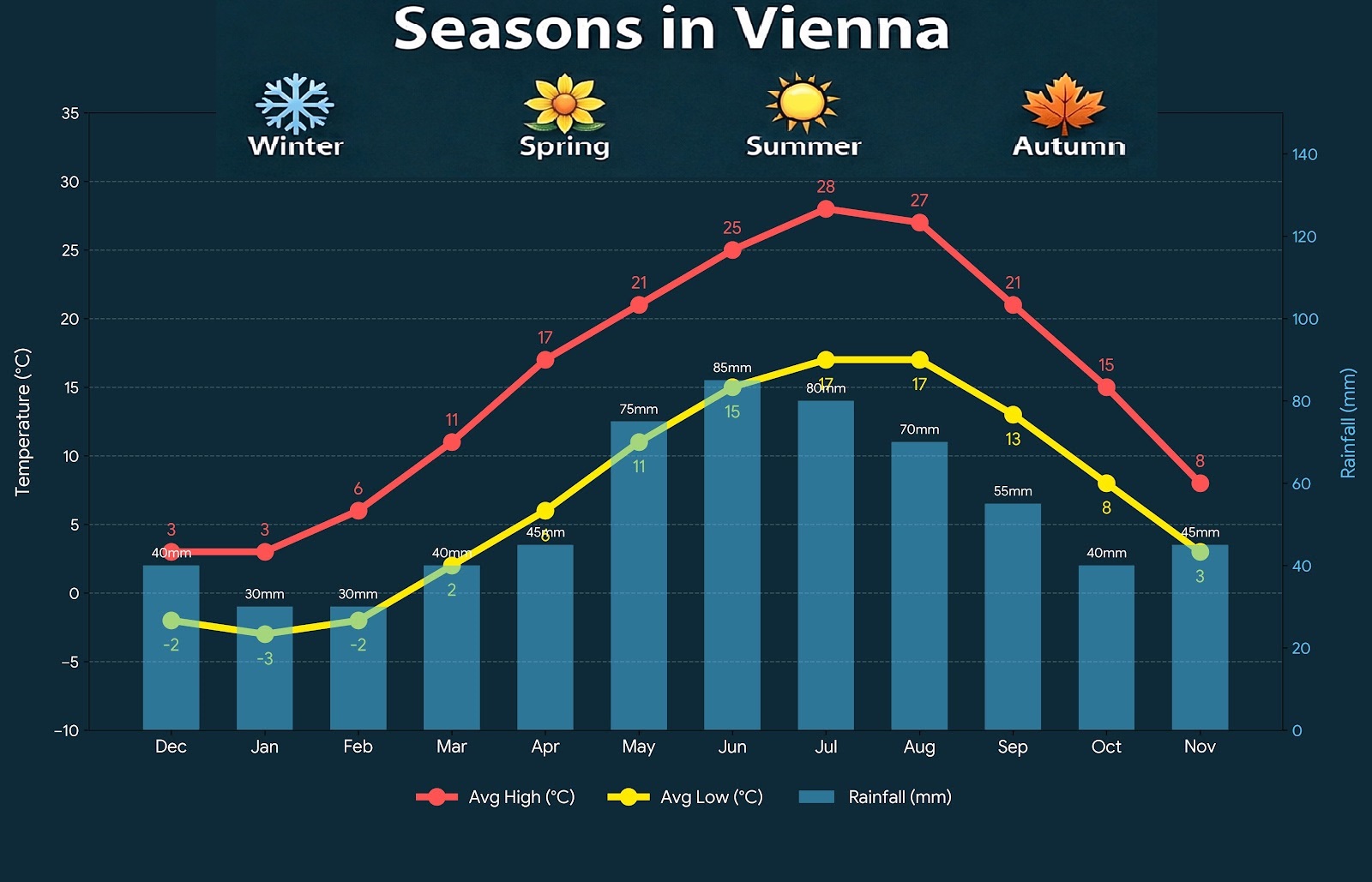
The Vienna climate is one of extremes, Summer often reaches 40 Celcius (100 Fahrenheit) weeks at a time.
Spring — March to May
Spring arrives in Vienna with an enthusiasm that feels earned after winter. By March the temperatures are climbing from the low single digits into the mid-teens. By April they are regularly in the high teens to low twenties. By May the Prater's chestnut trees are in blossom, the outdoor café terraces — the Schanigärten — are open, and the city is at its most visually agreeable. Daytime is warm and often sunny. Evenings still carry a chill that rewards a jacket.
March and early April bring the risk of rain and one or two late cold snaps. Neither is severe. Vienna's springs are not London's — the rain, when it comes, tends to arrive as proper showers rather than persistent drizzle, does its business, and leaves. Late April and May are consistently the most pleasant months of the year. The tourist crowds are building but have not yet reached summer intensity. Accommodation prices are reasonable. The parks are extraordinary.
If you are visiting for the first time and have complete flexibility, late April to mid-May is the answer most people who know Vienna well would give you.
Summer — June to August
Summer in Vienna is hot. Daytime temperatures in July and August regularly reach the high twenties and climb into the high thirties Celsius on the hottest days. Heat waves are becoming more frequent and more intense — the city has recorded temperatures above 40°C in recent summers — and Vienna's dense Baroque architecture, which is glorious to look at, provides very little shade and retains heat effectively.
Unlike London, where the buildings simply were not designed for heat, Vienna has adapted over centuries to its climate. Its Kaffeehäuser — the famous Viennese coffee houses — are cool, high-ceilinged refuges that reward visiting in the middle of a hot afternoon. The city's rivers and swimming facilities come into their own: the Danube Island (Donauinsel), a 21-kilometre-long recreational island between the Danube and the Neue Donau, is where the city goes in summer — a vast, free, open-air leisure facility with swimming, cycling, picnic areas, and a beach atmosphere that surprises most visitors who associate Vienna only with concert halls and museums.
Summer is also peak tourist season, which means queues at Schönbrunn and the Belvedere, higher hotel prices, and competition for restaurant tables at popular venues. The Vienna Festival (Wiener Festwochen) runs through May and June, bringing an extraordinary concentration of theatre, opera, and music to the city. The open-air Film Festival on the Rathausplatz, where classic films and opera performances are screened on a giant outdoor screen while audiences eat and drink in the square, runs through July and August and is free. These are compelling reasons to visit in summer. The heat and the crowds are the trade-offs.
Autumn — September to November
September in Vienna is, by a narrow margin, the finest month of the year. The summer heat has softened. The tourist hordes have thinned. The new opera and concert season opens in September, which means the Vienna Philharmonic, the State Opera, and the Musikverein are back at full programme after the summer break. The wine harvest in the Heuriger — the wine taverns in the vine-growing villages on the city's north-western edge, places like Grinzing, Sievering, and Neustift am Walde — produces the year's Sturm, a partially fermented new wine that Viennese drink by the carafe with cold cuts and bread in outdoor gardens surrounded by autumn vines.
October remains warm in the first half and begins to cool noticeably in the second. Fog is a feature of Viennese autumn — the city sits in a basin, and the Danube valley contributes a damp, low-lying mist on still autumn mornings that is either atmospheric or inconvenient depending on your disposition. The parks turn gold and amber. By November, winter is arriving and the outdoor terraces are closing.
For opera, music, and the pleasures of the table, autumn is the answer.
Winter — December to February
Vienna's winter deserves to be taken seriously, and not just because of the cold. December in particular is one of the most spectacular months in any European city. The Christmas markets — the Christkindlmarkt on the Rathausplatz in front of the lit-up City Hall, the market at Schönbrunn Palace, the more artisanal Spittelberg market in the 7th district — transform the city into something that has been reproduced on a thousand Christmas cards without any of them quite capturing the original. Mulled wine (Glühwein) in the cold night air in front of the illuminated Rathaus is a particular experience. Crowds are significant in December but the atmosphere earns them.
January and February are the city's quietest and most affordable months. Temperatures drop to between -5°C and 5°C, occasionally colder. Snow falls several times each winter, and when it does the city is very beautiful — the baroque palaces with snow on their rooftops, the Prater's paths under a white cover, the Danube greyish and cold in the winter light. The Vienna Philharmonic's New Year's Concert on 1 January, broadcast live worldwide, takes place at the Musikverein's Großer Saal in the heart of the city. Tickets for the concert itself sell by lottery years in advance. The live broadcast, watched in cafés and living rooms across Vienna, is participatory in its own way.
Hotel prices in January and February are as low as they get. Museums are uncrowded. The city's indoor life — the coffee houses, the restaurants, the concert halls — is at its richest. If the cold does not deter you, winter is a surprisingly rewarding time to be here.
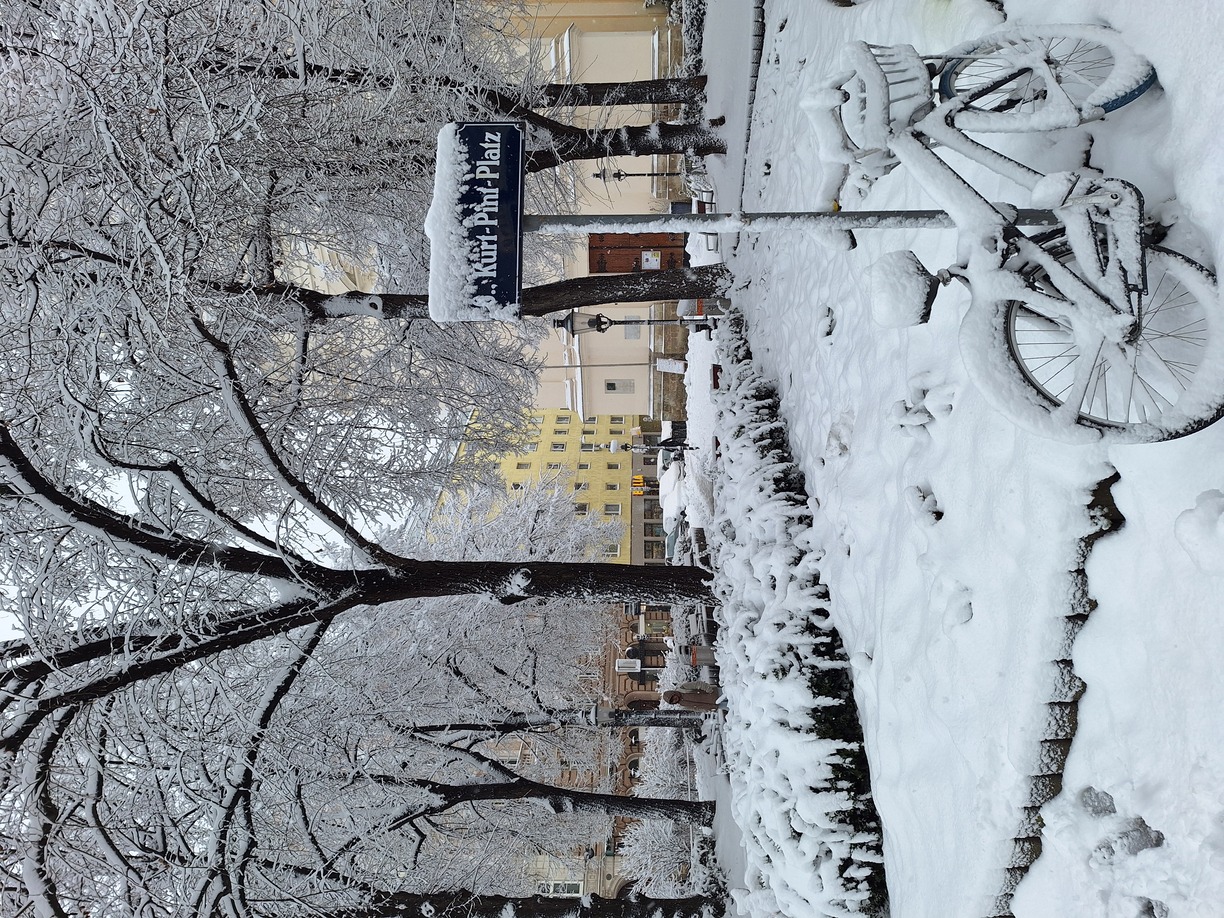
Occasionally there is heavy snowfall in Winter in Vienna. The city authorities are well-prepared for it. It turns the mundane into magical for a few days.
The Short Answer: When to Visit Vienna
🗓️ At a Glance
First-time visitors: Late April to May, or September.
Summer atmosphere and outdoor living: June to August — heat and crowds come with it.
Christmas magic: December — book well ahead. The Xmas markets bring in seasonal tourists.
Opera, quiet streets, low prices: January and February, with a good coat.
There is no bad time to visit Vienna. There is only the time that suits your trip — and the one that suits the next one.