
Getting Around Vienna as a Tourist
Vienna's public transport system is not merely good by the standards of tourist cities. It is one of the finest urban transport networks in the world, operated to a standard of punctuality, cleanliness, and coverage that makes getting around the city a genuinely pleasant rather than merely functional experience. The Wiener Linien — the city's transport authority — runs five U-Bahn (metro) lines, 29 tram routes, and 135 bus routes, plus a night network. The system operates on a flat-fare, integrated-ticket basis. One ticket covers all modes. It runs essentially around the clock. And if you are visiting from a city where "the trains are mostly on time" counts as a triumph, Vienna's expectation of precise punctuality will be a pleasant adjustment.
Tickets — The One Thing to Sort Before Anything Else
Buy a multi-day pass rather than a series of single tickets. This is not optional advice — it is the correct approach for any visitor spending more than a day in the city.
🎫 Ticket Prices at a Glance
Single journey: €3.20 (€3.00 via app)
24-hour pass: €8.00
7-day pass: €28.90 (paper) / €25.20 (digital, non-transferable)
Note: The 48-hour and 72-hour passes were discontinued in January 2026.
Make more than three journeys in a day and the 24-hour pass pays for itself. Most visitors make significantly more than three.
Buy tickets from machines at U-Bahn stations (English-language menu available), from the WienMobil app, or from the Vienna City Card desk at the airport. Validate your ticket before you travel — stamp it in the blue validation machine at the U-Bahn platform entrance or at the tram/bus stop. Inspectors are plainclothes, they operate throughout the network, and the fine for travelling without a valid validated ticket is €105. They are not rare.
The U-Bahn
Five lines cover the city in a pattern that requires a moment to understand and becomes instinctive within a day.
🗺️ The Five Lines
U1 (red) — Runs north-south through the centre, connecting Stephansplatz with the Hauptbahnhof.
U2 (purple) — Sweeps in a curve from the north-west through the city centre and out to the 22nd district.
U3 (orange) — Runs east-west through the centre.
U4 (green) — Follows the River Wien from Hütteldorf in the west through Schönbrunn, Karlsplatz, and out to Heiligenstadt in the north — the most tourist-relevant corridor.
U6 (brown) — Runs north-south on the western side of the city.
For tourists, the four most important U-Bahn stations are Stephansplatz (city centre, U1/U3 interchange), Karlsplatz (Belvedere, Naschmarkt, State Opera, U1/U2/U4 — the busiest interchange in the network), Schönbrunn (the palace, U4), and Schwedenplatz (old town's eastern edge, U1/U4). The U-Bahn runs from approximately 5am to midnight on weekdays, and all night on Friday and Saturday without interruption.
The Vienna U-bahn system is reliable, clean and quick. In rush hours this underground train system does get crowded and in Summer this can be unpleasant for some people.
The Viennese Trams
Do not dismiss the trams in favour of the U-Bahn for every journey. The tram network is extensive, operates on the same ticket, and for certain routes — particularly journeys along the Ringstrasse — it is both the most direct and the most beautiful option available. Tram D runs along the Ringstrasse past the State Opera, the Kunsthistorisches Museum, Parliament, City Hall, and the Burgtheater. Taking this tram at least once, ideally in the early morning before the crowds arrive, is one of the best free things you can do in Vienna. The buildings on the Ring were designed to impress from exactly this perspective, and they do.
Trams run on the surface and can be slower than the underground at peak hours. At off-peak hours they are often the most practical option for lateral journeys across the inner districts that would otherwise require changing U-Bahn lines.
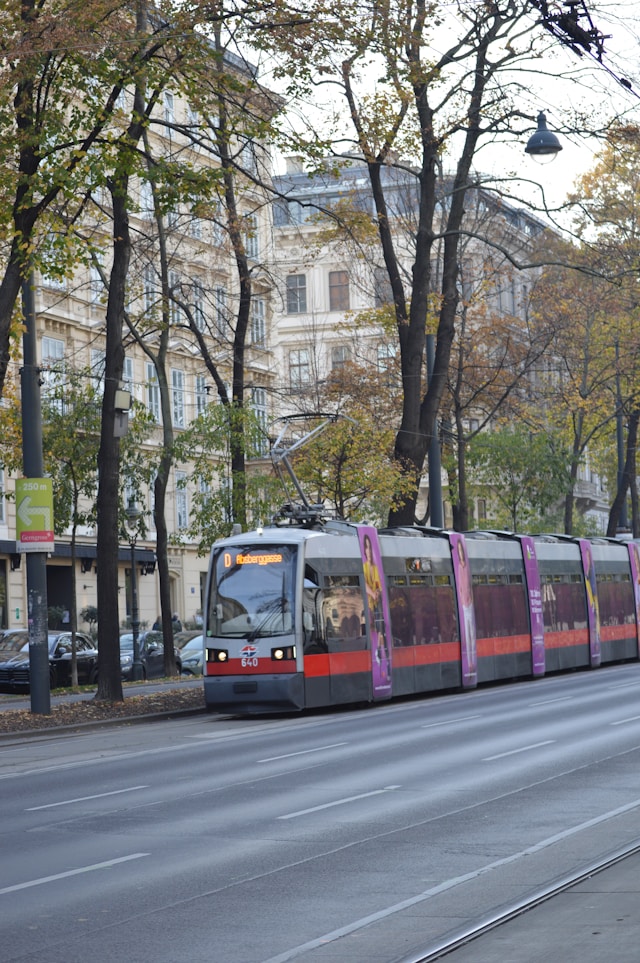
Trams in Vienna are a great way of seeing the city. Lines 1 and 2, which circle the Ringstrasse, passes top attractions like the State Opera, Hofburg Palace, Parliament, City Hall (Rathaus) and the Burgtheater.
Vienna Bus Network
Vienna’s bus network is an important part of the city’s public transport system and fills the gaps where the U-Bahn and tram lines do not reach. Operated by Wiener Linien, there are more than 120 bus routes running throughout the city, connecting residential neighbourhoods, outer districts, and areas that are not directly served by rail transport. Most buses operate roughly from 5:00 am until midnight, with services typically arriving every 5–10 minutes during the day. After midnight, Nightline buses (marked with an “N”) run approximately every 30 minutes until early morning, ensuring transport continues when the metro is closed.
Using Vienna’s buses is straightforward because the same ticket is valid across the entire network—U-Bahn, trams, and buses—so you do not need a special bus ticket. Simply board through the front or middle door and validate your paper ticket using the stamping machine if it has not already been validated.
Insider Tips
- Look for the yellow “Haltestelle” sign with a green “H”, which marks bus stops.
- If you miss a bus, don’t panic—another usually arrives within minutes on most routes.
- Routes 13A, 1A, 2A and 3A are especially useful for visitors because they pass through central areas and major sights.
- Download the WienMobil app for real-time departures and easy route planning.
The bus network does a good job of moving people around safely and quickly. You see far more from a bus or tram than being underground with the U-Bahn. This bus stop sign is at Stephansplatz, one of the tourist attractions in Vienna.
The Night Network
On Friday and Saturday nights, the U-Bahn runs continuously rather than closing at midnight. On other nights, a network of night buses replaces it, running half-hourly from a central hub at Schwedenplatz. Night buses are prefixed with N and follow the approximate routes of the day network. Vienna does not leave you stranded at 2am on a Tuesday in the way that some European cities do.
Taxis and Ride-Hailing
Vienna taxis are metered, regulated, and required by law to have a QR code visible from every passenger seat linking to the driver's licence details and a feedback mechanism. Legitimate Vienna taxis are identifiable by the roof sign and licence plates ending in TX, ATX, BTX, CTX, or DTX. Free Now is the main Vienna-specific app, supplemented by Uber and Bolt. All three are legitimate and fine to use.
A taxi from the city centre to Schönbrunn costs approximately €12–16. A taxi across the inner districts at night rarely exceeds €15. For groups of three or four splitting the cost, taxis are often competitive with the transport pass on individual late-night journeys.
Cycling in Vienna
Vienna is an exceptionally good cycling city. The Citybike Wien scheme places hire bikes at stands throughout the central districts — register via the Citybike app or at the stand with a credit card. The first 30 minutes are free; charges apply per hour thereafter. For sightseeing loops around the Ring or along the Danube Canal, a hire bike is one of the most enjoyable ways to cover ground. The Donauinsel has dedicated cycling paths stretching its entire length, and on a warm day it is outstanding.
The caution from the safety page bears repeating here: cycle lanes in Vienna are taken seriously by cyclists, who move at speed and expect pedestrians to be out of them. The lanes are red-surfaced and clearly marked. If you are walking, pay attention to them.
Do Not Rent a Car in Vienna
This needs saying plainly because some visitors consider it: do not rent a car to explore Vienna. Parking in Vienna is scarce, expensive, and in many areas simply not available to non-residents. It is becoming very much an "anti-car" city. Private cars are at the bottom of the pecking order in terms of right-of-way. Traffic is slow, stressful and the road layouts are complex. Cyclists and mopeds have lanes with their traffic coming towards you. Trams and buses have right of way over everybody and they just pull out when it suits them. There is no worse way to experience Vienna than driving around it. The public transport network will get you everywhere a car would, faster, with much less stress and at a fraction of the cost.
Prepared Traveller Tip for Vienna's Transport System
Buy the one-day pass or 7-day pass. Validate it before the first journey. Keep it for the duration. Do not buy single tickets for every journey — it costs more, takes longer, and there is no conceivable advantage. Vienna's transport system works best when you commit to it fully, and the full commitment costs less than dinner.