
Affiliate disclosure: Some of the links on this page are affiliate links. If you click through and make a booking, we may earn a small commission at no extra cost to you. This helps keep this website completely free and independent.
Is Vienna Safe for Tourists?
Let us dispense with the suspense immediately. Vienna is one of the safest cities on earth. Not one of the safest in Europe — one of the safest in the world, full stop. The Economist Intelligence Unit ranked it the most liveable city globally for multiple consecutive years. The Global Peace Index places Austria fourth in the world for peacefulness, behind only Iceland, Ireland, and New Zealand. Vienna's crime index sits at 26.85. London's is 53.77. Paris's is 61.21. These are not marginal differences.
If you have arrived at this page with genuine concern about your safety in Vienna, you can relax. The city will not ask much of you in the way of vigilance. What it will ask is covered below, and it amounts to the basic common sense you would apply anywhere.
Official guidance from the US State Department and the UK Foreign Office for Austria reflects this. Both rate it as a low-risk destination. Both note a general terrorism threat applicable to all of Europe — Vienna is not immune to the continent-wide risk — but neither identifies any specific ongoing threat to tourists in the city.
Vienna is divided up into 23 districts ("Bezirke"). The 1st District is where most of the tourist attractions are. After dark only the 10th District (Margareten), 2nd (Praterstern) and parts of the 16th (Ottakring) should be avoided. The rest of Vienna is safe to walk around at night. Reumannplatz in the 10th District is probably the only place to avoid any time of day.
What Crime Does Exist in Vienna
Violent crime directed at tourists in Vienna is exceptionally rare. The crimes that do occur in tourist areas are almost entirely petty: pickpocketing, bag snatching, and occasionally opportunistic theft from café tables and restaurant chairs. They are not random — they are concentrated in specific, predictable locations and operate in recognisable ways. Knowing where and how they happen is sufficient protection for most visitors.
The prime pickpocket territory in Vienna is the area around Stephansplatz — the square at the foot of St Stephen's Cathedral, the busiest point in the city — and the nearby pedestrian shopping zones of the Kärntner Strasse and the Graben. The U-Bahn stations at Stephansplatz, Karlsplatz, and Praterstern are also noted spots, particularly during rush hours and peak tourist periods. At Christmas, the famous Advent markets — Christkindlmarkt at the Rathausplatz and the Schönbrunn market in particular — draw very large crowds into compact spaces, and pickpockets know this as well as anyone.
The method is standard: a distraction — someone stumbles into you, asks you to sign a petition, points at something on the ground — while an accomplice removes what they came for. The petition scam is worth naming specifically because it is persistent in central Vienna and specifically targets tourists. A person approaches with a clipboard, speaks no German themselves (despite being in German-speaking Austria), and asks you to sign something for a charity or cause. While you are occupied, your pockets or bag are being examined. Do not stop. Do not engage. Keep walking.
Around Stephansplatz and Karlsplatz, people also sell tickets to classical concerts and Mozart-themed dinners. Some of these are perfectly legitimate. Others are overpriced events of mediocre quality sold by aggressive touts. Buy concert tickets only from official box offices or the venue itself. Vienna's musical heritage is extraordinary and entirely accessible without anyone on the street helping you access it.
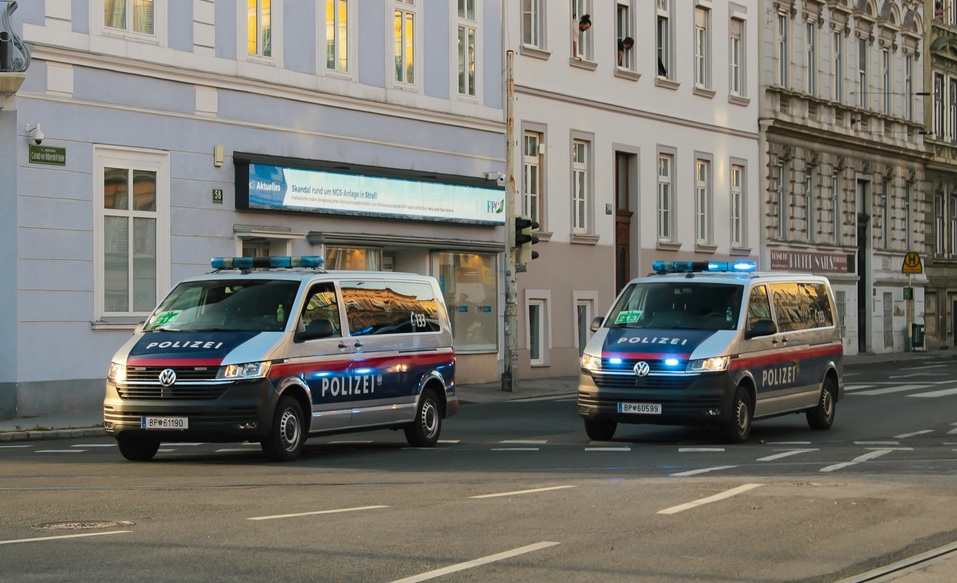
Austrian police wear dark blue uniforms. Their vehicles are clearly marked "Polizei" with their emergency number of 133 on them. It is not a "soft" police force; they are direct and firm. Generally their level of proficiency in English is surprisingly good and they don't mind being approached by tourists.
Vienna Train Stations: Safe or Not?
Vienna's main rail stations — the Hauptbahnhof (main station) and Westbahnhof — and their immediate surroundings, particularly after dark, require a little more awareness than the tourist centre. The area around Praterstern U-Bahn station, in the 2nd district, has a rougher atmosphere in the evenings than the rest of the city centre. The same is true of Gumpendorfer U-Bahn station in the 6th District. None of these areas are dangerous in any serious sense, but they are where the small amount of crime Vienna does generate tends to concentrate. Be alert, keep your belongings secure, and move through with purpose rather than lingering. If you hang around these stations too long, eventually an unsavoury person might approach you, offering to sell you drugs.
Trains between Vienna and Budapest, Prague, or Rome have been specifically noted by several official sources for pickpocket activity. On overnight and cross-border trains, keep your valuables close and your compartment door secured if you sleep.
Where Tourists are at risk: Cycling and Pedestrian Lanes
This is not a conventional safety section but it deserves its place here. Vienna has an extensive and heavily used cycling infrastructure, and the lanes are not always obviously separated from pedestrian paths. Cyclists in Vienna move at speed and take their right of way seriously. Wandering from the pedestrian zone into a cycling lane — which tourists do constantly, being unfamiliar with the markings — produces near-misses and occasional collisions. Pay attention to the red surface markings that designate cycling paths, and stay out of them. The cyclists will not necessarily slow down to accommodate you.
Similarly, crossing the road on a red pedestrian light — which in most European cities passes largely without comment — is a fineable offence in Austria. The fine is modest but real. More to the point, Viennese pedestrians simply do not cross on red, and doing so makes you conspicuous in a way that is mildly embarrassing. Wait for the green man, it only takes seconds.
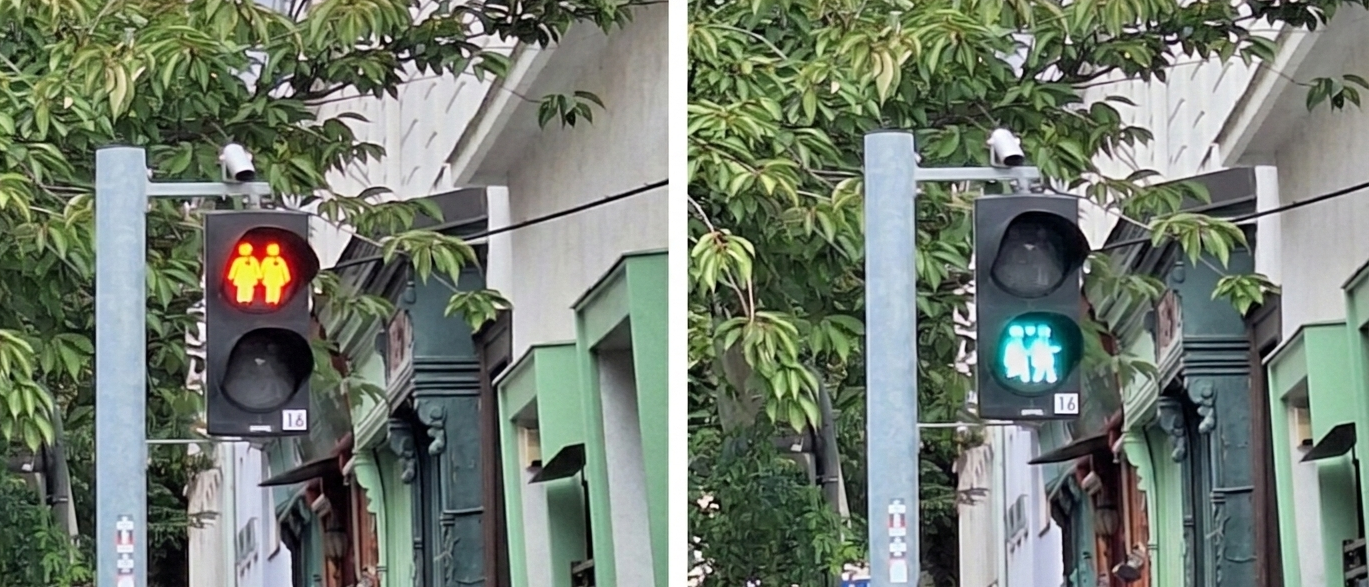
In many parts of Vienna the pedestrian lights involve couples. Just because you think it is safe to walk doesn't mean it actually is - traffic flows in ways you won't expect in Vienna. Do as the locals do and you'll be safe.
At Night
Vienna is safe at night. The central districts — the 1st through the 9th — are well-lit, well-policed, and active well into the early hours on weekends. Women travelling alone report high levels of comfort here, which is a reliable indicator of genuine safety rather than theoretical safety. The Naschmarkt area after the market closes, and certain quieter streets in the outer districts, simply reward the same awareness you would apply in any city after midnight: stick to lit streets, be aware of who is around you, and trust your instincts.
Emergency Numbers
📞 Austrian Emergency Numbers
112 — Pan-European emergency number. Works in Austria for police, ambulance, and fire.
133 — Police (Polizei)
144 — Ambulance (Rettung)
122 — Fire (Feuerwehr)
All operate around the clock. Police in Vienna are professional, visible in tourist areas, and approachable. Most officers in the central districts speak enough English to be practically helpful.
The honest summary: Vienna requires less safety vigilance from its visitors than almost any comparable city in the world. The appropriate level of alertness is low. The appropriate level of complacency is also low. Keep your bags zipped in the tourist centre, ignore the petition people, and buy your concert tickets from box offices. That is genuinely all that is needed.
Travel Insurance for Vienna: Don’t Assume You’re Covered
Vienna has one of the best healthcare systems in Europe—efficient, modern, and reliable.
But for visitors, the key issue isn’t quality. It’s access and cost.
If You’re Visiting from the UK
UK travellers can use a GHIC (Global Health Insurance Card) to access medically necessary state healthcare in Austria.
However, this comes with clear limitations:
- No cover for private treatment
- No cover for repatriation to the UK
- Some costs may still need to be paid upfront or reclaimed later
A GHIC is useful—but it is not full protection.
If You’re Visiting from the US or Elsewhere
You will NOT have automatic access to Austria’s public healthcare system. In many cases, treatment must be paid for upfront.
Emergency care is available—but billing still applies if you’re not insured.
The Practical Reality
Austria’s healthcare system works extremely well—but it assumes you’re already covered within it.
For travellers, that often means dealing with:
- Upfront payments
- Administrative complexity
- Gaps between public and private care
Why Good Travel Insurance Matters Here
Travel insurance removes those gaps. It gives you access to private care if needed, covers repatriation, and avoids uncertainty around costs.
It’s less about risk—and more about avoiding friction in a system that isn’t designed for visitors.
The link below is an affiliate link. If you make a purchase through them, we may earn a small commission at no extra cost to you.
Compare Travel Insurance OptionsVisitorsCoverage lets you compare multiple travel insurance providers all in one place. It is particularly well suited to US travellers, while offering options for all nationalities. You can choose just medical cover or just trip insurance or both. This marketplace offers many options to suit every wallet.
Compare your insurance options here →Typical Situations Where Insurance Helps
- Upfront payment for doctor or hospital visits
- Accessing private care to avoid delays
- Medical transport or repatriation
- Trip disruption due to illness or unexpected events
What It Could Cost Without Insurance
- Doctor consultations: paid upfront
- Hospital treatment: potentially significant out-of-pocket costs
- Repatriation: very high cost depending on circumstances
- Travel changes: expensive last-minute bookings