Last updated: April 2026
Affiliate disclosure: Some of the links on this page are affiliate links. If you click through and make a booking, we may earn a small commission at no extra cost to you. This helps keep this website completely free and independent. Thank you for your support.
The Cape Town Practical Guide: Money, Electrics, Emergencies, Water & Culture
The things that derail a trip are rarely the big ones. You planned for those.
It's the small, assumed, "nobody-told-me" details — the plug adapter that doesn't fit at midnight, the moment of genuine confusion when someone tells you to "turn left at the robot", or not knowing which ambulance to call — that create the real friction.
This page gives you the South African practicalities in plain terms: the currency, the electricity situation, what to do in a medical emergency, the water, the essential phone numbers, and a guide to the remarkable cultural mosaic you are about to walk into. Read it before you pack.
Money — The South African Rand
The currency is the South African Rand, abbreviated as ZAR and written with the symbol R. You will see prices displayed as R250 or R1,200. The Rand is divided into 100 cents, though the very smallest coins are rarely used in practice. Most retailers round up or down to the nearest 5 cents. Banknotes come in denominations of R10, R20, R50, R100, and R200. The notes are colourful and easy to distinguish — each features the face of Nelson Mandela on the front and one of the "Big Five" animals (lion, elephant, rhino, leopard, buffalo) on the reverse. If you find yourself holding a note and wondering which is which, the R200 features the leopard — the rarest of the five to spot in the wild, fittingly the highest denomination.
The Rand floats freely on international currency markets and has historically been volatile. It tends to be weak relative to major currencies like the US Dollar, Pound Sterling, and Euro, which makes South Africa — and Cape Town in particular — genuinely excellent value for international visitors. Restaurants, wine, accommodation, and activities all feel significantly cheaper than their equivalents in Western Europe or North America. That is not an accident: the exchange rate is doing most of the work.
Card payments are widely accepted in Cape Town's hotels, restaurants, shopping centres, and most tourist-facing businesses. Visa and Mastercard work without issue. American Express is less universally accepted. That said, carry a reasonable amount of cash — street food vendors, craft markets, car park machines, informal traders, and some smaller guesthouses operate on a cash-only basis. Use ATMs inside banks or shopping malls rather than standalone street machines, for the same reasons you would anywhere in the world. Avoid dynamic currency conversion: if the machine or card terminal asks whether you'd prefer to pay in your home currency rather than Rand, always choose Rand. The offered rate will be unfavourable.
Currency exchange at the airport is convenient but predictably expensive. Better rates are available from banks and reputable forex bureaus in the city. For day-to-day spending, a multi-currency travel card such as Wise is a practical solution: transactions clear at the real mid-market rate, your balance is visible in real time via the app, and you can freeze the card instantly if it is lost or stolen.
Tipping is customary and genuinely appreciated. Restaurants: 10–15% for good service. Petrol station attendants (South Africa has no self-service fuel): R5–R10. Car guards in parking areas (an informal but widespread system): R5–R10 when you return to your car. Hotel porters and tour guides: use your judgment based on service received.
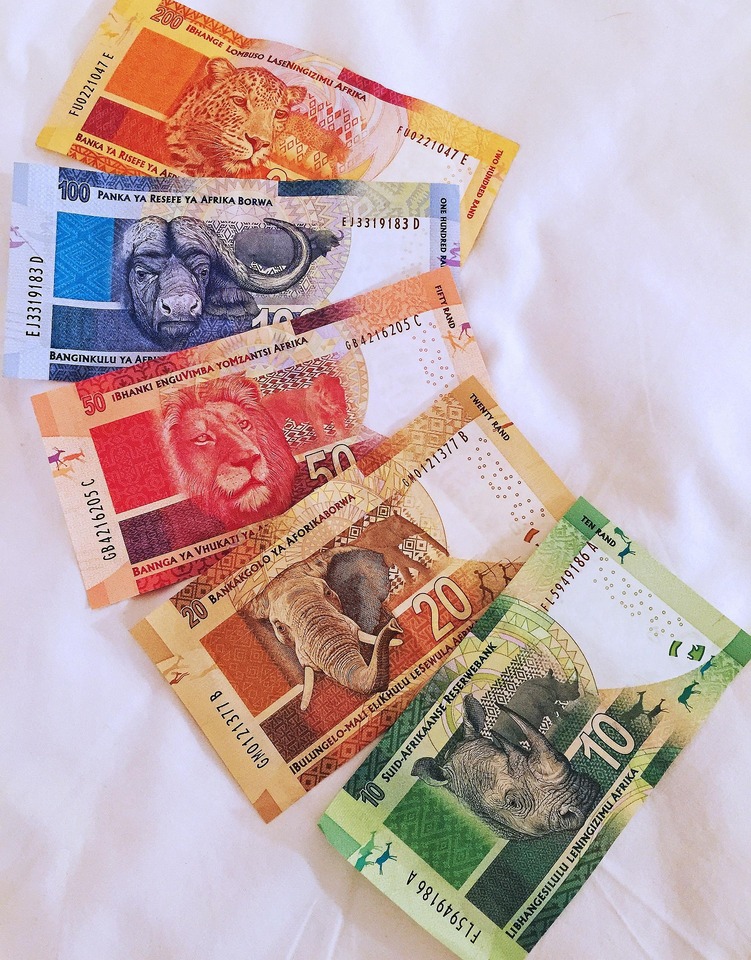
South Africa bank notes of the various denominations.
The Wise card for Cape Town — this one is about more than saving money
Card fraud in Cape Town (and South Africa) is real. It can happen at petrol station forecourts or at restaurants where your card might be taken to a machine out of your sight. Card skimming — where a device reads and clones your card data — is among the most reported tourist complaints in the country. Most visitors arrive without knowing this. Their bank card is linked to their full account. If it's cloned, everything in that account back home is at risk.
The Wise card limits your exposure.
Wise is a separate financial account, disconnected from your main bank. Before you fly, you transfer what you plan to spend initially into your Wise account. If your card is skimmed, stolen, or cloned, a fraudster can only ever reach that balance. Your regular bank account at home is entirely out of reach.
And if anything does look wrong, you freeze the card instantly from the app. Right now, from wherever you are. If the card is physically stolen, you cancel it immediately from the same app. The money on it will still be in your account. If you had your Wise card added to Apple Pay or Google Pay, the digital card continues working even if the physical card needs replacing.
Beyond the safety case, the card saves you money in a city where your regular card is quietly working against you. Every purchase you make with your bank card in South Africa is subject to your bank's exchange rate markup and a foreign transaction fee. The Wise card uses the real mid-market rate with no foreign transaction fee. It's the same for ATMs: Wise is the cheapest way to draw Rands from a machine, using the real rate, with a free monthly withdrawal allowance built in.
Cape Town petrol stations and some older terminals will offer to charge your card in your home currency rather than Rand. Always decline, pay in Rands.
You add more money onto the card via the app. Any money still on the card when you get home you can transfer back to your bank account, without any fees involved. The card works in most countries of the world, so if you travel regularly, it will benefit you on future trips too.
Get the Wise card before your Cape Town trip →Affiliate link — I may earn a small fee if you sign up, at no cost to you. I've been using Wise for years, it keeps my travel plans safe and saves me money.
Electrical Sockets, Voltage & Load Shedding
Plugs and Voltage
South Africa uses its own distinctive plug system. The most common socket takes a Type M plug — three large round pins arranged in a triangle, at 15 amps. This is unique to South Africa and a handful of other African and South Asian countries. You will not find this plug in Europe, the Americas, or Australia. A dedicated South African Type M adapter is what you need. Universal adapters may include the correct pin configuration, but check before you buy.
Newer buildings in South Africa are increasingly fitted with Type N sockets as well — a Brazilian-standard two-round-pin system that is gradually being adopted as South Africa's preferred new standard. The good news is that many modern hotels provide multi-standard outlets or USB charging points that bypass the adapter problem entirely. Do not assume this; bring an adapter.
The mains voltage is 220–230V at 50Hz. This is the same standard used in the United Kingdom, Europe, and Australia. If you are travelling from one of those regions, your devices will work without a voltage converter — you only need a physical plug adapter. If you are arriving from the United States or Canada (where the standard is 110–120V), check the label on each device carefully. Look for the input specification: if it reads "Input: 100–240V", it is dual-voltage and will work fine with only an adapter. If it reads "Input: 120V" only, you need a step-down voltage converter as well. Hair dryers, straighteners, and some older electric shavers are the most frequent culprits. Plugging a 120V-only appliance directly into a 230V socket will very likely destroy it, possibly dramatically.
Adapters are available at Cape Town International Airport shops, at major supermarkets such as Pick n Pay and Checkers, and at electronics retailers including Game and Incredible Connection. They cost a fraction of what the airport charges if you find one before you fly.
"Load Shedding" — What It Is and Where It Stands Today
No discussion of South African electricity would be complete without mentioning "load shedding" — the scheduled, rolling power cuts implemented by Eskom, South Africa's national power utility, when electricity demand exceeds the generating capacity of the national grid. Load shedding is implemented in numbered "stages" that indicate how many hours per day a given area will be without power. At its worst, in 2022 and 2023, South Africa experienced Stage 6 load shedding — up to 12 hours without power per day — and it became a significant national crisis and a genuine irritant for tourists.
The situation has improved substantially. Major daily load shedding ended in March 2024, and through 2025 South Africa experienced only a handful of hours of load shedding across the entire year. As of early 2026 the national grid is stable, with Eskom citing improved generation capacity and reduced unplanned outages. Whether this stability holds over the long term remains to be seen — the structural problems that caused the crisis did not evaporate overnight — but for now, visitors are unlikely to encounter it.
If load shedding does return during your trip, the practical impact for tourists is usually limited. The major hotels, restaurants, and shopping malls in Cape Town all have backup generators;they kick in after a few seconds. Your dinner plans will survive; at worst expect a brief interruption and a menu that doesn't include items requiring particular equipment. Keep a portable power bank charged as a matter of habit for your phone or laptop. Check the current status at loadshedding.eskom.co.za or ask your accommodation.
Health & Medical Emergencies
This is the section to read carefully, because getting it wrong is expensive...or worse.
South Africa has a two-tier healthcare system. The public (government) hospital system is chronically under-resourced, severely understaffed, and operating under considerable strain. Accident and emergency departments at government hospitals in Cape Town are frequently overwhelmed. Waiting times of many hours are common for non-critical cases. Equipment can be outdated. The standard of care varies enormously. As a foreign tourist, you should treat a government hospital as a last resort — the place you go only if there is absolutely no alternative and you need stabilisation right now.
The private hospital system, by contrast, is genuinely world-class. Facilities such as Netcare Christiaan Barnard Memorial Hospital and Mediclinic Cape Town are modern, well-equipped, and staffed by skilled medical professionals. The level of care is genuinely comparable to the best private hospitals in the UK or Europe. If you need medical attention in Cape Town, the private system is where you want to go. This makes comprehensive travel insurance with medical coverage not merely advisable but effectively essential. Without it, private hospital costs will be your responsibility: a general consultation runs from R500 to R3,000; an emergency room visit from R1,500 to R5,000; a hospital stay can run to R3,000–R5,000 per night in a general ward before any treatment costs are added.
For a genuine medical emergency — serious accident, chest pains, difficulty breathing, severe allergic reaction, suspected stroke — call one of the two major private ambulance services immediately. These are advanced life support services with trained paramedics and, in ER24's case, air ambulance capability:
🚑 Private Ambulance Services — Call These First
Netcare 911 — 082 911
Nationwide private emergency medical service. Available 24 hours. Covers all of Cape Town. This is one of the two numbers you should save in your phone before you leave home.
ER24 — 084 124
Advanced life support ambulance service, registered with the Health Professions Council of South Africa. Includes aeromedical evacuation capability for serious incidents in remote areas. The other number you must have saved.
Both services will dispatch to your location and transport you quickly to an appropriate private hospital. If you are in a genuine life-threatening emergency and need immediate direction, you can also dial 112 from any mobile phone (this works even without credit or a local SIM) and the operator will route you to the relevant emergency service.
For non-emergency medical issues — a minor injury, illness, or anything that can wait a short while — pharmacies (called chemists or simply pharmacies in South Africa) are a useful first stop. Major chains include Clicks and Dis-Chem, found in most shopping centres. South African pharmacists are qualified to advise on and treat a wide range of common ailments, and many medications that require a prescription elsewhere are available here over the counter.
Travel Insurance for Cape Town — There Is No Safety Net Here
South Africa has no reciprocal healthcare agreement with any country in the world. That changes the calculation entirely.
Most travellers arrive in Cape Town having given insurance roughly the same amount of thought they'd give it for a trip to Europe — a brief consideration, maybe a quick policy purchase, possibly nothing at all.
That's a mistake worth correcting before you land.
Unlike the UK, France, Australia or most of the EU, South Africa has no reciprocal healthcare agreements with other countries. None. Your EHIC card, your Medicare card, your provincial health card — none of them carry any weight here. You are a private patient from the moment you walk through the hospital door, regardless of where you're from.
What private healthcare in South Africa actually costs
Cape Town has excellent private hospitals, but they are private businesses and they will ask for proof of insurance or a substantial deposit before treating non-emergency cases.
A single night in a private hospital in Cape Town can cost R15,000–R30,000 (roughly $800–$1,600 USD). A stay involving surgery, ICU, or specialist care compounds quickly. And that's before you factor in the cost of getting home.
Medical evacuation from Cape Town to the US, UK or Europe typically costs $40,000–$100,000. That figure alone is the argument for travel insurance.
State hospitals are technically open to all. In practice, they are under severe resource pressure and not an environment any visitor should plan around. They are a last resort, not a fallback.
Beyond medical: where insurance earns its keep in Cape Town
Medical cover is the headline, but it's not the only reason insurance makes sense for a Cape Town trip specifically.
Theft and personal belongings
Cape Town is worth being honest about: opportunistic theft is a reality, particularly in tourist-heavy areas. Phones, cameras and bags left visible in cars or carried carelessly in busy areas do get taken. A policy with solid personal belongings cover handles this. Your home or renters insurance may not extend internationally — check before you assume.
Trip disruption
Long-haul flights to Cape Town — from the US, UK or Europe — involve connections and significant cost. A missed connection or cancelled flight that requires rebooking at short notice can easily run to hundreds or thousands in fare differences. Insurance covers this. Paying out of pocket is painful at that distance.
Adventure activities
Cape Town draws people who want to do things: shark cage diving, abseiling off Table Mountain, kite surfing in Blouberg, hiking in the Winelands. Many standard policies exclude adventure activities or require a specific add-on. If your itinerary involves anything beyond sightseeing, check your policy's activity list before you buy.
The link below is an affiliate link. If you make a purchase through it, we may earn a small commission at no extra cost to you.
Compare Travel Insurance Options
VisitorsCoverage lets you compare multiple providers in one place — medical-only, trip cover, or both. Suitable for all nationalities, with options at every price point.
Compare your insurance options here →What to look for before you buy
- Medical coverage limit — given South Africa's private hospital costs and the distance from home, a minimum of $500,000 in medical cover is sensible. Higher is better.
- Medical evacuation / repatriation — confirm this is explicitly included and check the limit. Evacuation from Cape Town to the US or Europe is expensive. This is not optional cover.
- Adventure activities — if you're diving, surfing, hiking, or doing anything with a pulse, verify your specific activities are covered before you buy, not after an incident.
- Personal belongings — check the single-item limit. A camera or laptop may exceed the default limit; declare high-value items or get a policy that covers them explicitly.
- Pre-existing conditions — disclose accurately. Claims denied for non-disclosure are common and easily avoidable.
- Trip cancellation terms — for long-haul trips, "cancel for any reason" cover is worth paying extra for. Standard cancellation cover requires a documented qualifying reason.
- Excess / deductible — a lower premium often means a higher excess. Factor this into your comparison rather than defaulting to the cheapest option.
What it could cost without insurance
- One night in a Cape Town private hospital: R15,000–R30,000 (~$800–$1,600 USD)
- Surgery or specialist care: costs multiply rapidly — easily R100,000+
- Medical evacuation to the US or Europe: $40,000–$100,000+
- Last-minute long-haul flight rebooking: potentially $1,000–$3,000 in fare differences
- Stolen phone or camera: replaced entirely out of pocket
- Trip cut short by illness or family emergency: unrecoverable accommodation and activity costs
The short version
For most destinations, travel insurance is a sensible precaution. For Cape Town, it is a practical necessity. There is no healthcare backstop, private care is expensive, and the distance from home makes any serious incident significantly more costly to resolve.
A policy that covers all of the above typically costs less than a decent dinner in Cape Town. The comparison doesn't need to be made more complicated than that.
Sort your cover before you fly
Compare travel insurance by destination, activity level and coverage type — and buy in minutes.
Compare on VisitorsCoverage Affiliate link — we may earn a small commission at no cost to you. We only recommend services we'd use ourselves.Emergency Telephone Numbers
📞 Key Numbers for Cape Town
112 — Universal emergency number from any mobile phone. Routes to police, fire, or ambulance. Works without a local SIM and without credit. This is your catch-all emergency number.
107 — Cape Town City emergency number. Police, fire, ambulance and general emergencies within the city. Landline or mobile.
10111 — South African Police Service (SAPS). Equivalent to 999 in the UK or 911 in the US. For police emergencies across South Africa.
10177 — Government ambulance service. Public sector emergency medical services. Use this only if the private services above are genuinely unreachable.
082 911 — Netcare 911. Private paramedics. Save this before you travel.
084 124 — ER24. Private paramedics, including air ambulance. Save this before you travel.
021 937 0300 — Metro Rescue Control / Wilderness Search and Rescue. For incidents on Table Mountain, in the national park, or in the mountain wilderness areas. Cape Town's mountains see a significant number of rescue callouts each year.
021 948 9900 — Cape Town Mountain Rescue (Western Cape).
021 689 5227 — Poison Information Helpline (National Red Cross, Cape Town). For suspected poisoning, bites, or toxin exposure.
If your passport is lost or stolen, report it to the police on 10111 or at any police station, then contact your country's consulate or embassy in Cape Town or Pretoria immediately. Know your consular contact information before you travel — it is not the moment to be searching for it.
Drinking Water
Cape Town's tap water is safe to drink. The City of Cape Town operates a rigorous water treatment and monitoring programme, testing close to 6,000 water samples per year. The water meets both South African National Standards (SANS 241) and World Health Organization guidelines. You do not need to buy bottled water to stay healthy in Cape Town. Most locals drink the tap water daily without a second thought.
That said, the water is noticeably more heavily chlorinated than tap water in much of Western Europe or North America, which gives it a faint chemical taste. This is an aesthetic issue, not a safety one. A carbon filter jug — which many local residents use — removes the taste almost entirely. Chilling the water in the fridge also helps. If you find the taste off-putting in your first day or two, it is not a sign of a problem; your palate will adjust.
One practical caveat: older buildings with rooftop tanks or corroded pipes can occasionally introduce their own issues even when the city supply is perfectly fine. If water coming from a particular tap looks discoloured or smells unexpectedly of sulphur, switch to bottled water and let your accommodation host know. Cape Town is well-stocked with bottled water and it is inexpensive.
If you are venturing outside the city — along the Garden Route, into rural areas, or hiking in remote parts of the Cape — the tap water quality becomes less predictable. In those contexts, bottled water is the sensible choice.
The Day Zero Story
Cape Town has a significant place in the recent global history of urban water management, and it is worth knowing about. Between 2015 and 2018, the city experienced three consecutive years of critically low rainfall. The reservoirs supplying Cape Town — most notably the Theewaterskloof Dam, which holds more than half the city's water supply — fell to catastrophic levels. By early 2018, the main dams were at around 26% capacity and dropping fast.
City officials coined the term "Day Zero": the projected date on which the municipal water supply would be shut off entirely and Cape Town's four million residents would have to collect a daily ration from 200 centralised water points, each serving the equivalent of a small town. It would have been the first time in modern history that a major city ran out of water. The initial Day Zero date was set for April 2018. The world watched.
It never arrived. Through a combination of emergency demand restrictions (residents were limited to 50 litres per person per day), aggressive tariff hikes for high users, new desalination plants, diverted agricultural water, and a remarkable collective behavioural change by Capetonians themselves, the city reduced its water consumption by nearly 60% from 2015 levels. Day Zero was pushed back, and then the 2018 rains arrived. By 2020, the Theewaterskloof Dam was full again.
The lasting effect is a city that is more water-conscious than almost anywhere else on earth. Locals take short showers, fix leaks immediately, and remain genuinely proud of how they managed the crisis. If your hotel has water-saving signage in the bathroom, it is not theatre — it is institutional memory. The water is safe and plentiful today, but Cape Town earned its respect for it.
Culture — The Rainbow Nation in One City
South Africa calls itself the Rainbow Nation. It is not empty marketing. Cape Town is one of the most genuinely culturally complex cities on the planet — a place shaped by indigenous peoples, Dutch colonists, British imperialism, enslaved Malays from the East Indies, waves of migration, and the long shadow of apartheid. Understanding something of the cultures you will encounter here will make your visit significantly richer.
The Xhosa
The Xhosa people are the dominant indigenous African culture in the Western Cape, and the largest Black population group in Cape Town. isiXhosa — their language — is one of South Africa's 11 official languages and is notable to foreign ears for its distinctive click consonants, incorporated directly into speech as consonant sounds. Nelson Mandela was Xhosa. So was Archbishop Desmond Tutu. The cultural influence of the Xhosa on Cape Town's townships, music, and political life is profound and ongoing.
Xhosa culture places great emphasis on communal identity, ceremony, and the wisdom of elders. Storytelling, music, and intricate beadwork are central to cultural expression. The ulwaluko initiation ceremony — marking a young man's transition into adulthood — is taken very seriously and is an important private rite. They paint their faces white and wear blankets; if you encounter such young men approach with genuine curiosity and respect, and it will be returned with warmth.
The Cape Malay Community
The Cape Malay community is one of Cape Town's most distinctive and historically significant cultures. Their ancestors were brought to the Cape as slaves by the Dutch East India Company in the 17th and 18th centuries — political exiles and enslaved people from Indonesia, Malaysia, and other parts of Southeast Asia. They brought Islam with them, and the Cape Malay community remains predominantly Muslim today, with the mosques of Bo-Kaap and the surrounding area reflecting a tradition stretching back over 300 years.
The most visible physical expression of Cape Malay culture is Bo-Kaap, a neighbourhood on the slopes of Signal Hill whose cobbled streets and brilliantly coloured Georgian houses — painted in vivid pinks, greens, yellows, and blues — are one of Cape Town's most photographed sights. The colours are not decorative whimsy; they represent the community's celebration of freedom following the abolition of slavery. The Cape Malay culinary tradition — fragrant, spice-rich curries, bobotie (a baked spiced mince with egg custard topping), koeksisters (syrup-soaked fried dough), and samoosas — has become woven into the fabric of South African cooking more broadly.
Every year on 2 January, the city erupts with the Kaapse Klopse (Cape Town Minstrel Carnival) — a jubilant parade of thousands of costumed musicians and dancers through the city streets, with ghoema drumming and choral singing. It is one of Africa's most joyful spectacles and dates back to the days of slavery. If your visit coincides with it, do not miss it.
The Coloured Community
The term "Coloured" — used in South Africa as a demographic and cultural identity rather than a pejorative — refers to a community of mixed heritage whose ancestry combines Xhosa, Khoikhoi (the indigenous people of the Cape), Cape Malay, Dutch, German, British, and other influences. It is a community unique to South Africa, born of centuries of colonial mixing at the Cape, and it constitutes the majority demographic group in Cape Town by a significant margin. Most Coloured Capetonians speak Afrikaans as their first language — a language that itself evolved in the Cape from Dutch, with contributions from Malay, Khoikhoi, and Portuguese.
The history of the Coloured community is inseparable from the worst of apartheid's social engineering. The Group Areas Act of 1966 forcibly relocated tens of thousands of Coloured and Indian families from central Cape Town to the Cape Flats — the flat, wind-swept plains to the east of the city. District Six, a vibrant mixed neighbourhood near the city centre, was bulldozed. The scars remain in Cape Town's urban geography and in living memory.
The Afrikaner Culture
The Afrikaners are the descendants of Dutch, German, and French Huguenot settlers who arrived at the Cape from the mid-17th century onwards. Their language, Afrikaans — one of South Africa's 11 official languages — evolved in the Cape from Dutch, absorbing influences from Malay, Portuguese, and local African languages. It is the youngest fully developed European language on earth, and it is spoken by more people as a first language in Cape Town than any other language.
Afrikaner culture is characterised by a fierce attachment to the land, family, Calvinist religious tradition, and — perhaps above all — the braai. The braai (rhymes with "try") is not simply a barbecue. It is a social institution, a cultural event, a reason to gather. Afrikaner families will braai in rain, in wind, and on public holidays designated specifically for the purpose. Heritage Day (24 September) is informally but universally observed as National Braai Day. If you are ever invited to a braai, go. The food will include boerewors (farmer's sausage, spirally coiled), lamb chops, and braaibroodjies (toasted sandwiches on the grill). The experience will be "lekker".
The English-Speaking Community
Cape Town also has a substantial English-speaking white community, descendants of British settlers who arrived during the colonial period when many Europeans arrived at the same time. The Winelands towns of Stellenbosch, Franschhoek, and Paarl reflect this European influence in their architecture and culture. Franschhoek — "French Corner" — was settled by French Huguenot refugees in the late 1600s, and the wine-making tradition they established continues as one of the world's great wine regions, now accessible in under an hour from Cape Town's city centre. The English settlers rarely ventured away from Cape Town into the hinterland; their descendents remain clustered in certain suburbs in the west of the city. Almost everybody speaks English as their second language and it is a compulsory subject in all schools across the country. Road signage is almost always in English first, as are most public signs of any kind.
A Note on Ubuntu
Running through all these cultures — Xhosa, Zulu, Coloured, Afrikaner — is a philosophy that South Africans refer to as Ubuntu. The Nguni phrase from which it derives translates roughly as "I am because we are" — the idea that individual humanity is inseparable from community. You will feel it in practical form in Cape Town: in the warmth with which strangers give directions, in the way communities gather around shared food, in the patience and good humour with which most Capetonians navigate the very real difficulties of daily life in a city that is still working through the consequences of its history. It is not a tourist abstraction. It is real, and it is one of the things that makes Cape Town one of the most emotionally generous cities on earth.
South African Phrases & Slang — A Survival Guide
English is widely spoken in Cape Town, and you will have no difficulty communicating. However, South African English is a distinct dialect that borrows freely from Afrikaans, isiXhosa, isiZulu, and a dozen other influences. The result is a local vocabulary that can briefly confuse even native English speakers. Here are the words and phrases most likely to stop you in your tracks.
| Word / Phrase | What it actually means |
|---|---|
| Howzit | A greeting. Short for "How is it?" Used the way a British person says "alright?" or an American says "hey". You do not need to answer with a status report. "Howzit" back is perfectly correct. |
| Robot | A traffic light. When someone says "turn left at the robot", they mean the traffic lights. No actual robots are involved. This will confuse you exactly once. |
| Just now | At some point in the future. Not immediately. Not urgently. If someone says they'll do something "just now", they mean soon-ish. "Now now" means sooner. "Now" means immediately. The system is internally consistent, if baffling to visitors. |
| Lekker | Nice. Good. Great. Delicious. Enjoyable. The most versatile positive adjective in the South African lexicon. From Afrikaans. The braai was lekker. The wine was lekker. Cape Town is very lekker. |
| Braai | A barbecue. But more than a barbecue — it is a social event, a cultural institution, and a reason to spend an entire afternoon outdoors. To braai is also a verb. "We're going to braai tonight." |
| Eish | An exclamation of surprise, frustration, sympathy or disbelief. From Khoikhoi via Xhosa and Zulu. You will hear it everywhere. "Eish, that traffic was bad." Pronounced "aysh". |
| Ag | Afrikaans "oh". A versatile sigh or expression. "Ag, man" = "oh, come on." "Ag, shame" = a sympathetic "oh, poor thing." Pronounced with a guttural "ch" like the Scottish "loch". |
| Shame | Not a negative word. In South Africa, "shame" expresses sympathy or endearment. A baby being called "shame, he's so cute!" is receiving a compliment. "Ag, shame man" to someone who missed their flight means "that's rough, poor you." |
| Bakkie | A pickup truck. If someone asks you to follow the red bakkie, they mean the pickup truck, not some item of obscure bakery equipment. |
| Biltong | Dried, cured meat — South Africa's answer to beef jerky, though locals will take mild offence at the comparison. Available in every petrol station, supermarket, and sports event. Often made from beef, but also from springbok, kudu, or ostrich. It is excellent. Try it. |
| Boerewors | Literally "farmer's sausage" in Afrikaans. A spiced, spirally coiled sausage that is the centrepiece of any respectable braai. Pronounced approximately "boo-ruh-vors". |
| Ja-nee | Literally "yes-no" in Afrikaans. Means "well, yes" or "I understand" or sometimes just a thoughtful acknowledgement. It is not contradictory; it is agreement with nuance. |
| Sharp / Sharp sharp | Goodbye, or everything is fine and in order. "Sharp sharp" said as a farewell means everything is good. Often accompanied by a slight nod or thumbs up. |
One final piece of cultural orientation: South Africans are, as a general rule, extraordinarily friendly; a recent global survey proved this. They are especially good-humoured about their country's complexities and contradictions. They will laugh about the load shedding, mock their own politicians with relish, and cheerfully discuss the things that don't work. This self-deprecating wit is not despair — it is resilience. Match their energy and you will get on very well here.