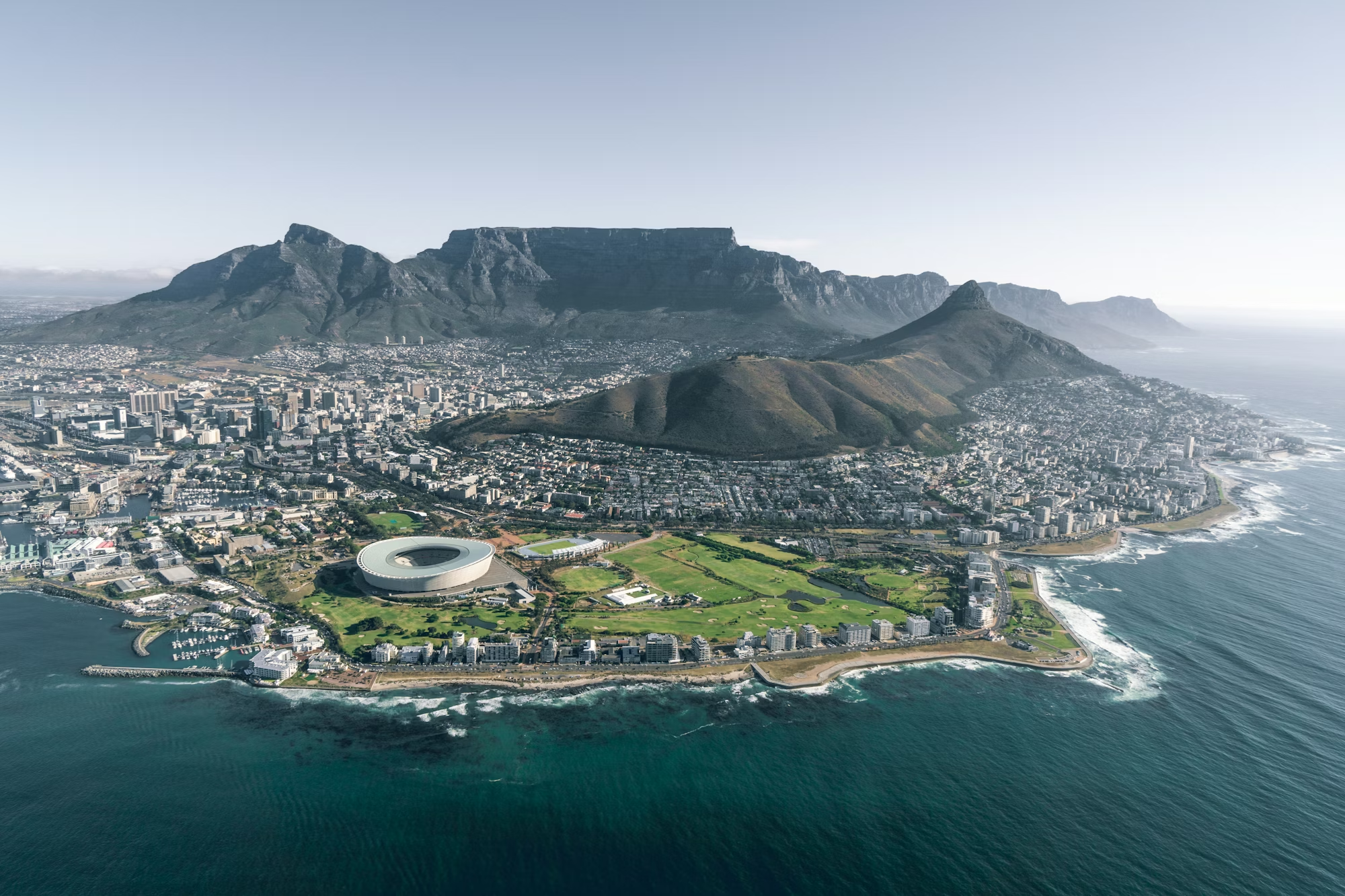
Cape Town for Digital Nomads
A criterion-by-criterion assessment for location-independent workers
"They come for two weeks and stay six months. Then they leave and spend the next year trying to figure out how to come back."
Cape Town has that effect on people. But before you book a one-way ticket to the Mother City, you deserve an honest reckoning with what the city offers against the criteria that actually matter to location-independent workers.
We assessed Cape Town across thirteen criteria drawn from established nomad priority research — scoring each one, calling out the good, the bad, and the genuinely ugly, and flagging the resources that exist specifically for remote workers in the city.
1. Cost of Living
A single adult can live comfortably in Cape Town for approximately $800–$1,000 per month, depending on lifestyle and accommodation choices. A more comfortable digital nomad lifestyle — nicer apartment, active social life — runs closer to $1,500–$2,500 per month. Either way, this is remarkable value for a city with Cape Town’s quality of food, culture, and scenery.
The Rand’s weakness against the US Dollar and Euro works heavily in a foreign earner’s favour. Eating out is genuinely cheap by Western standards, wine from the Winelands is world-class and costs a fraction of what it would elsewhere, and monthly co-working memberships near the city centre typically range from $50 to $150. The community co-working space 22Fifty charges just R450 per month — less than half what any other space in the city charges.
One of the best-value cities of its calibre anywhere in the world.
2. Internet & Connectivity
Cape Town has a solid fibre backbone. Most accommodation in the city centre, Sea Point, and Camps Bay comes with fast fibre, and most co-working spaces run connections ranging from 10Mbps to 200Mbps. The issue is consistency outside those controlled environments. Café speeds as low as 7Mbps are common — workable for most tasks but punishing for heavy video calls or large uploads.
The real wildcard was load shedding — South Africa’s system of rolling, scheduled power outages lasting 2–4 hours at a time, often once or twice a day. At the time of writing - February 2026 - there have not been noticeable outages in almost a year.
Most cafés and many Airbnbs do not have Wi-Fi routers on inverters, so outages mean zero connectivity. The saving grace is that the better co-working spaces have generators or solar backup. The EskomSePush app provides advance schedules, usually a day in advance - IF it happens. Seasoned nomads simply build outages into their working day; go to a beach or out for a run. It is also possible to move yourself to another part of the city that has electricity.
Excellent in the right spaces, unreliable everywhere else.
3. Visa & Legal Status
The picture has improved considerably. South Africa introduced a formal Remote Work Visa in 2024 for foreign remote workers earning at least ZAR 1 million per year (~€48,000), requiring proof of income, health insurance, accommodation, and a clean criminal record.
A Digital Nomad Visa was formalised in March 2025, with a lower threshold of $35,700 annually.
For those below that bar, citizens of the US, UK, and most EU countries receive an automatic 90-day visa-free entry, extendable once for a further 90 days — giving six months of legal stay without a special visa. The caveat: visa extension requests have a reputation for disappearing entirely into the immigration bureaucracy. Don’t expect a swift response.
Getting better fast, though the formal Remote Work Visa income threshold is steep.
4. Safety
No honest guide sidesteps this: Cape Town is a dangerous city. There are areas to avoid entirely, and even in relatively safe neighbourhoods, vigilance is non-negotiable. Muggings — most commonly at night — are a reality that a significant proportion of long-term residents have experienced firsthand, ranging from phone snatching to more serious incidents.
That said, context matters enormously. Most violent crime occurs well away from the areas where nomads live and work. Green Point and Sea Point are the recommended base neighbourhoods — walkable, well-lit, dense with cafés and co-working spaces, and substantially safer than elsewhere. Using Uber rather than walking at night, not displaying valuables, and maintaining basic situational awareness are the baseline rules. Thousands of nomads live here happily. It is about strategy, not fear.
Manageable with street smarts, but demands awareness that most other nomad cities do not require.
5. Co-Working Infrastructure
Cape Town punches significantly above its weight here. The range of spaces is wide, quality at the top end is excellent, and — crucially — several have specifically addressed the load-shedding problem with backup power.
Key Spaces
- - Workshop17 — V&A Waterfront & multiple locations: Premium, reliable, and widely cited as having the fastest Wi-Fi in the city. The flagship Waterfront location overlooks the working harbour.
- - Ideas Cartel — De Waterkant: Industrial-chic space with a strong community vibe — and specifically confirmed as load-shedding immune.
- - Cape Town Office — Gardens: Open since 2011. Fast internet with seamless backup during outages, a podcast studio with professional recording gear, phone booths, free meeting rooms, dog-friendly, solar-backed.
- - CHIPS Coworking: Solar backup for both lights and internet — a genuine lifesaver during outages and purpose-built for the Cape Town connectivity challenge.
- - Roamwork: Hot desks, private rooms, call booths, and meeting rooms. Covered in commissioned art; promotes creativity by design.
- - 22Fifty: The community favourite: far cheaper than competitors at just R450/month, with a loyal regular crowd.
- - WeWork: Global-chain reliability and amenities in the CBD for those who need the brand assurance.
One of the city’s strongest selling points for remote workers, with options for every budget and working style.
6. Community & Networking
Other digital nomads, locals, and remote workers are everywhere — particularly in co-working spaces, cafés, and weekend events. Many expats say they made friends for life here. The Cape Town Digital Nomads Facebook group, run by Johannes Völkner (founder of the Nomad Cruise), posts meetups and facilitates connections across the community.
That said, Cape Town lacks the centralised nomad ghetto found in cities like Medellín or Lisbon — there is no single street or neighbourhood of nomad-specific activity. Remote workers tend to get absorbed into local social life, which is wonderful for longer stays but can make the first few weeks of a shorter visit feel harder to crack than expected.
Rich community potential, but requires more active effort than in some more established nomad hubs.
7. Climate
Cape Town’s Mediterranean climate is genuinely exceptional — if you time your visit correctly. Summers (November through March) are warm, dry and breezy, with temperatures moderated by the cold Atlantic. The “Cape Doctor” south-easterly wind is a feature of summer life, occasionally blowing patio furniture off balconies. Winters (May through September) can feel frigid despite mild thermometer readings (average July high: 17°C / 64°F) because virtually no residential or commercial buildings have central heating or double-glazing.
Outstanding in summer; underwhelming in winter, especially indoors.
8. Quality of Life & Lifestyle
This is where Cape Town simply cannot be beaten at anything close to its price point. Table Mountain, Lion’s Head, and Devil’s Peak are all within easy reach of the city centre. The restaurant scene is world-class. The coffee culture is serious. The wine from Stellenbosch and Franschhoek is extraordinary and costs a fraction of what it would in Europe. Capetonians place enormous cultural weight on a healthy work-life balance, and that attitude is contagious — you will go hiking, swimming, and wine tasting on weekday afternoons, and you will not feel guilty about it.
You can start your morning with a cappuccino under Table Mountain, work from a design-forward co-working space in the afternoon, and end your day watching the sky turn pink on the Camps Bay coastline. This is not a marketing brochure, this is what the days in Cape Town actually look like.
Arguably the best quality of life per dollar of any major city in the world.
9. Healthcare
South Africa’s private healthcare system is functional, accessible, and reasonably priced relative to American costs. Private hospitals in Cape Town are modern and well-staffed. The public system, however, is severely strained, and nomads without comprehensive travel insurance would be taking a genuine financial and life risk. International health coverage is non-negotiable before arriving.
Fine with insurance, risky without it. Budget for solid international health coverage.
10. Time Zone Compatibility
South Africa Standard Time (UTC+2) does not observe daylight saving. This makes Cape Town ideal for nomads working with European clients or teams, with comfortable morning-to-midday overlap for video calls and collaboration. For US-based workers, the 7–9 hour gap ahead of American time zones makes synchronous collaboration deeply uncomfortable. Cape Town richly rewards those with European or Africa-facing client bases, and quietly penalises those chained to US schedules.
A city that rewards European-schedule nomads and penalises American ones.
11. Transport Connectivity
Cape Town is not a convenient city to travel to if you are based in Europe or Southeast Asia. Getting here typically requires a long-haul international flight, and travel within Africa tends to be expensive with limited routing. This makes Cape Town a destination rather than a waypoint — you come here deliberately for a meaningful stay, not as a stop on a multi-city loop.
Once inside the city, Uber works well and is the de facto transport option for most nomads. The MyCiTi bus system covers limited areas. Renting a car is strongly recommended for anyone staying longer than a few weeks — it unlocks the Winelands, the Garden Route, and Cape Point, and makes the city feel dramatically more accessible. Without a car, the city’s car-centric layout can feel limiting.
Isolated geographically; easy to get around once there, hard to reach and expensive to leave.
12. English Proficiency
English is one of South Africa’s eleven official languages and the dominant language of commerce, media, and daily life in Cape Town. There is zero language barrier for English-speaking nomads. The local professional and expat community communicates entirely in English.
As frictionless as it gets.
13. Tech & Startup Ecosystem
Cape Town brands itself as a tech startup hub and backs it up with substance. The city has a growing ecosystem of tech companies, creative agencies, and fintech startups. Workshop17 in particular is a regular venue for startup events and pitch nights. The scene doesn’t approach Lisbon or Berlin in scale or density, but it is a genuine, functional ecosystem rather than a marketing claim — useful for nomads who want to network, find clients, or tap into local professional life.
A real tech scene, if not yet a major one.
The Ugly Truth: Inequality
No honest guide about Cape Town can close without confronting this. The city’s visible poverty and deep socioeconomic inequality are emotionally challenging for many nomads — and the contrast is relentless. Cape Town’s issues mirror those of deeply unequal American cities: inner-city homelessness, gentrification, racial and economic stratification, and car-centrism that insulates wealth from poverty.
The corrugated metal of Langa township sits minutes from the international airport. The electric fences of Woodstock and Vredehoek are a daily reminder of the city’s fractures. For nomads who are thoughtful about where they plant their laptops and their dollars, this context can weigh on the experience. Cape Town’s extraordinary beauty and its extraordinary inequality exist in relentless, uncomfortable proximity. That is not something any honest guide can paper over.
Resources Specifically for Digital Nomads
The following resources exist specifically for, or are heavily used by, remote workers in Cape Town.
- - Cape Town Digital Nomads Facebook GroupRun by Johannes Völkner, founder of the Nomad Cruise. Posts meetups, facilitates introductions, and is the primary community entry point for arriving nomads.
- - EskomSePush AppEssential. Tracks your specific area’s load shedding schedule with push notifications. Set it up before your first day of work.
- - Cape Co-LivingColiving accommodation and nomad-specific city guides. Useful for first-time arrivals or those wanting a built-in community from day one.
- - Workshop17 (workshop17.com)Premium co-working across multiple Cape Town locations. The fastest reported Wi-Fi in the city. Strong events programme for networking.
- - CHIPS CoworkingSolar-backed, specifically designed to be immune to load shedding. Purpose-built for the Cape Town connectivity challenge.
- - Cape Town Office — Gardens (capetownoffice.co.za)Independent space open since 2011. Podcast studio with professional equipment, phone booths, dog-friendly, solar-backed internet.
- - Nomadlist — Cape Town PageLive crowd-sourced scores and recent reviews from nomads currently in the city. Useful for real-time temperature checks.
- - The Entertainer App2-for-1 deals on restaurants, activities, and spas. Worth the R595 annual membership within a week of arrival.
- - Vodacom or MTN SIMThe recommended local SIMs for data coverage. Buy one at the airport and use it as connectivity backup during load shedding outages.
The Full Scorecard
Thirteen criteria, scored against the priorities that research consistently identifies as most important to digital nomads when choosing a base.
| Criterion | Score |
|---|---|
| Cost of Living | 8 / 10 |
| Internet Reliability | 6 / 10 |
| Visa Access | 7 / 10 |
| Safety | 5 / 10 |
| Co-Working Infrastructure | 9 / 10 |
| Community & Networking | 7 / 10 |
| Climate (Summer) | 9 / 10 |
| Quality of Life | 9 / 10 |
| Healthcare | 6 / 10 |
| Time Zone (EU-facing) | 8 / 10 |
| Transport Connectivity | 5 / 10 |
| English Proficiency | 10 / 10 |
| Tech & Startup Ecosystem | 7 / 10 |
| Overall | 7.3 / 10 |
Cape Town is not the easiest nomad city in the world, and it is not trying to be. It is the kind of place that rewards people who stay long enough to understand it — to learn which neighbourhoods to avoid after dark, which co-working space has a generator, and where to find the best natural wine at 3pm on a Thursday. Do that, and you will understand why the people who come for two weeks keep finding excuses to stay for six months.
The mountain is right there, the ocean is right there, the food is extraordinary. And for what it costs relative to what it offers, there is genuinely nothing else like it on earth.
For nomads working European hours who value lifestyle and can handle some adventure: Cape Town belongs near the top of your list.