Arriving in Cape Town
Visas, ETA & Customs Declaration Form
1) Do you need a visa?
Whichever airport you land at first, most nationalities are granted visa-free stay of up to 90 days. For the vast majority of passports from North America and Europe it really is as simple as getting on a plane, presenting your passport at passport control in SA to get it stamped – and there are no fees involved for this. This has not changed.
The vast majority of tourists arrive at Cape Town International Airport. Make sure that your luggage tag says “CPT”. If you are coming directly from outside South Africa you'll go through passport control in Cape Town. If you entered South Africa (SA) elsewhere, usually Johannesburg airport (luggage tag is JNB, called O.R. Tambo Airport), then that is where you'll first clear passport control.
It is possible to have your tourist stay extended by another 90 days, but only once. If you wish to stay longer then you must declare this upon arrival and need to have secured an appropriate visa before arriving – but this all depends on your passport.
At this official government webpage you can see your exact tourist visa entitlement. Yours is likely to be under the “ordinary” column.
Click here for Visa-Exempt Countries for tourists to South Africa2) Do You Need an ETA?
South Africa's Electronic Travel Authorization (ETA) was officially launched 12 August 2026. At this stage it is only mandatory for passport holders from China, India, Indonesia, and Mexico who need a visa to enter South Africa. If you hold a passport from a visa-exempt country – this covers essentially all of Europe, the UK, the US, Canada, and Australia/NZ – you do not need an ETA to enter. Your existing 90-day visa-free entry is unaffected.
Home Affairs has said it plans to add more nationalities “over the coming weeks” through the rest of 2026, and once your country is added, visa-exempt travellers will still only need the ETA on a voluntary basis, to use faster biometric arrival lanes – it won't become compulsory for exempt nationals in this next phase. There's no fixed date yet for when (or if) that changes for European/North American passports, so this page will be updated again once it does.
If you do need an ETA (i.e. you're from one of the four listed countries):
- Apply at: eta.dha.gov.za – it cannot be obtained on arrival
- Fee: ZAR 500 (introduced 17 August 2026)
- Processing: within 24 hours; apply before you travel
- Validity: up to 90 days, with one 90-day extension available online
- Entry points: OR Tambo (JNB), Cape Town (CPT), and Lanseria (HLA)
- Present the QR code (digital or printed) at immigration
⚠️ If your nationality does require an ETA and you arrive without one, you will be denied entry.
3) Mandatory: Online Traveller Declaration (Separate From Your Visa)
This is new, and it catches a lot of people out because it has nothing to do with your visa or the ETA above – it's a customs requirement, and it applies to everyone, including passport holders who are completely visa-exempt.
Since 1 July 2026, all travellers entering or leaving South Africa by air, land, sea, or rail must submit an online Traveller Declaration through the South African Traveller Management System (SATMS), replacing the paper customs card that used to get handed out on the plane. You'll need to declare currency, commercial goods, or anything over the duty-free allowance; ordinary luggage and personal items don't need to be declared.
- Submit at: the SARS Traveller Declaration Portal, the SATMS app, or via a Scan-to-Declare QR code at the airport
- Apply online at: https://www.sars.gov.za/travellerdeclaration/
- When: within 24 hours before your final flight into South Africa
- Cost: free
- If you forget: you won't be denied entry – SARS officials and self-service kiosks at the airport will help you complete it on the spot – but it will slow you down, so do it before you fly
Practically: budget five minutes on your phone the day before you fly, sort your ETA (if it applies to you) separately and earlier, and you'll walk straight through on arrival.
Last verified: 28 August 2026.
Flights
Many airlines offer cheaper fares to JNB and it can work out cheaper to book yourself onto one of the 6 local low-cost airlines to CPT if you want to spend time in JNB and environs first. Especially if you are booking at short notice, direct flights to CPT are likely to be expensive. It might again be a case of a flight to JNB being more affordable, then waiting around having a meal at JNB before catching a local scheduled flight to CPT. There are as many as 42 daily flights between the two cities and the flying time is 2 hours.
Be advised that having a changeover timeframe of less than 2 hours to connect yourself to the local flight is risky if coming in on a long-haul flight. Fours hours is more than adequate. You'll need to get yourself from International Arrivals to Domestic Check-in/Departures. OR Tambo is not a great airport, but a huge, busy sprawling mass. It's not a pleasant introduction to South Africa but you'll be able to get a decent meal. The Spur at the food court serves any type of food, any time of day. The Ocean Basket is a great choice if seafood is for you.
The best way to start your adventure in Cape Town is to arrive by air in the morning. You'll have had some sleep on the plane overnight and if you're coming from Europe the time zone is almost the same, thus there is no jetlag to fight off. Bright sunlight will embrace you as you disembark; an exciting new day awaits. Welcome to Cape Town!
The major European carriers have daily flights almost all year round. Singapore Airlines lands in CPT 4 times a week, but touches down in JNB first. Cathay Pacific flies from Hong Kong to JNB. American Airlines has indicated that it might commence flights to CPT later in 2026. LATAM from Sao Paulo will start in September 2026.
Below is a table depicting a typical day of long-haul international arrivals. Exact times might vary by day of the week. Treat this table as a rough guide and know from your booking what the exact times for your flights are.
| Airline | Route | Arrival Time |
|---|---|---|
| Air France | Paris | 6:00 AM |
| KLM | Amsterdam | 6:15 AM |
| Lufthansa | Munich | 7:40 AM |
| British Airways | London Heathrow | 8:00 AM |
| Qatar Airways | Doha | 10:30 AM |
| Condor | Frankfurt | 11:00 AM |
| Lufthansa | Frankfurt | 11:00 AM |
| Emirates | Dubai | 12:00 PM |
| Turkish Airlines | Istanbul | 12:00 PM |
| Virgin Atlantic | London Heathrow | 12:00 PM |
| British Airways | London Heathrow | 12:00 PM |
| Ethiopian Airways | Addis Ababa | 2:30 PM |
| United Airlines | Washington | 4:00 PM |
| Emirates | Dubai | 5:00 PM |
| Delta Airlines | Atlanta | 7:00 PM |
| KLM | Amsterdam | 10:00 PM |
Depending on the season, charter airlines join the options, especially in the Summer months. Examples are: Norse from Gatwick arrives at 10am and Edelweiss from Zurich lands at 10.50am. The local airlines land as late as 11.35pm. The day is then over and the airport starts to go quiet. Don't worry if you're landing late, there is adequate security...and free wi-fi.
After you disembark the plane you'll walk along a corridor for a minute or two until you arrive at the International Arrivals Passport Control hall. South African passport holders join the queues to the left and all other passports are to the right. No passport gets preferential treatment here, all nationalities are equal. Enjoy standing and stretching your legs while you await your turn for a counter to become available. Simply step forward with your passport in hand. This formality should take less than a minute, after which you can collect your luggage.
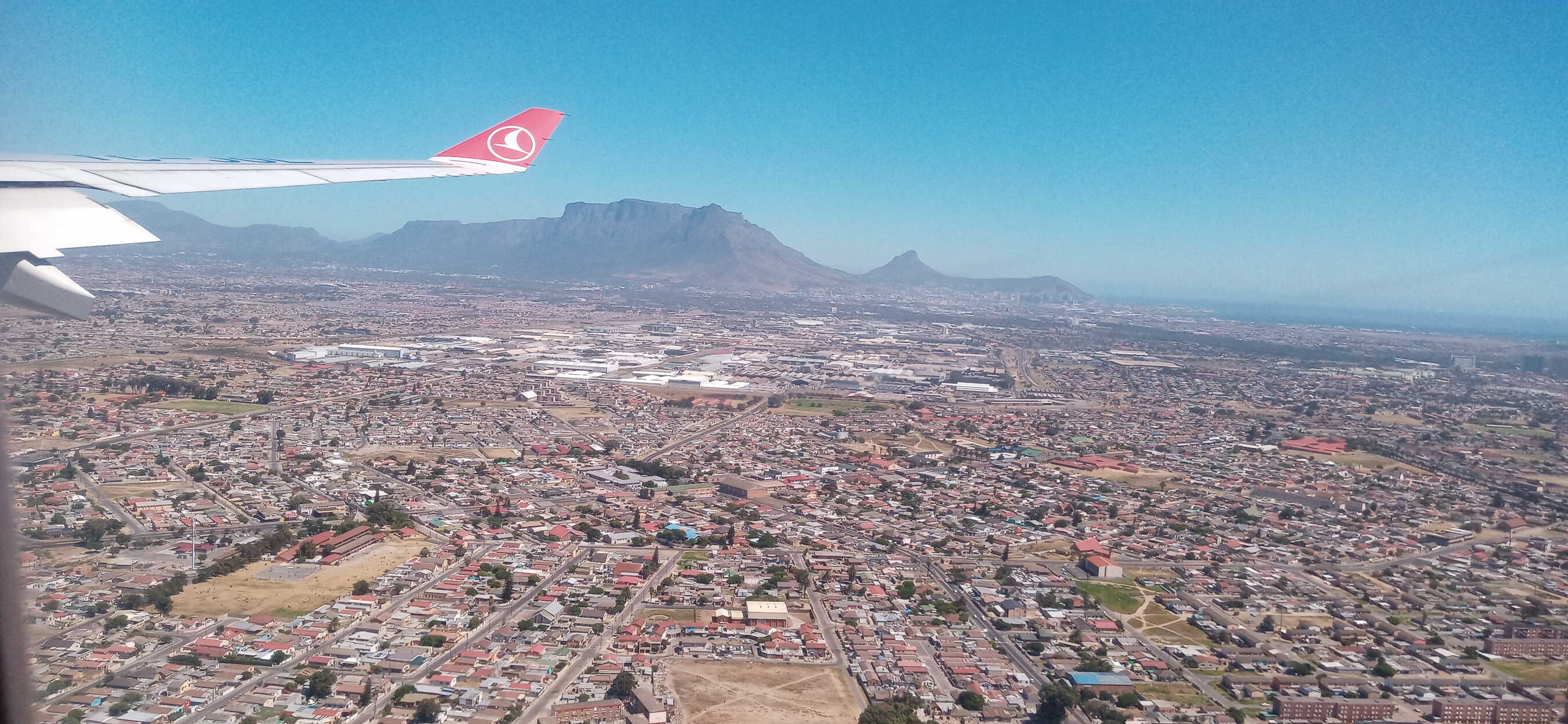
Most long-haul flights coming in to land at Cape Town have this view of the city. In this shot is a side view of Table Mountain with Lion's Head visible. Try to get your seat allocation to be on the right-hand side of the cabin.
SIM Cards
Something you might want to get at the airport is a local sim-card for your phone. Your network from home is likely to work (just give it a minute or two to connect) but the charges will be a nasty shock when you get back home. So-called “e-sims” are a viable option but they usually work out to costing more than twice the price of a sim on the local network. These “e-sims” only really offer value because of their unlimited data, but you haven't come to Cape Town to watch Netflix in a room, have you? If you're a digital nomad needing to upload huge videos daily, then that is the best option.
As you exit the International Arrivals door, immediately to your right is two counters for the two biggest local cellular network operators – Vodacom and MTN. The former is the local subsidiary for Vodafone. If your current plan is with Vodafone from the UK, then this network on your phone should allow you to connect but at a hefty price of almost £8 a day and up to £49 for 14 days, plus data quotas. MTN is a South African success story in that it has over 800 million subscribers, serving Africa and large parts of Asia. (I use this network.) There is a third network operator – Cell-C – but their coverage is patchy. MTN and Vodacom have almost perfect coverage across the country.


You join the queue for one of the counters and simply say to the lady who will serve you, “Good morning. How are you? I would like a tourist sim please.” It is incredibly important to greet the person serving you in South Africa – you will get better service for doing so. Never be rude unless the other person was rude first. It is part of the good vibe here. (Everybody speaks English here, but for 90% of people it is as a second language.) Minimum wage in South Africa is about US$2/£1.50 an hour. Manners don't cost anything and in South Africa they're worth a lot.
The lady will reply and ask for your passport. She'll then ask you which plan you want by presenting you with a rate card. Rather get too much data than too little; it's cheap. You can top up if you need to again by going into one of their shops that dot the city. You'll be presented with a form (so-called RICA) to sign. You have to sign this; it is your giving the SA government permission to access and analyse your calls, messages and data if they believe they have just reason to. At least they are honest about it. Most governments of the world do this but they don't ask their citizens at all. "Burner phones" do not exist in South Africa.
The lady will do the necessary processing and give you your new sim; it's yours to keep and still valid for 6 months after your last top up. You can insert this new sim yourself but if you want you can ask her to do it for you. They have the tools there and do it several times a day. You can make a test call to her to see that everything is in order. Just remember to thank her. This task should take no more than 10 minutes.
After that you can get yourself and your luggage to whichever transport option you have decided on. It might be a long drive to where you're staying, so it is a good idea to use the airport toilets (restrooms/WC) because you don't know when you'll get your next chance.
Transport Options from Cape Town Airport
Sadly there is very limited transport choices at Cape Town's airport. There are city council authorised taxis, Uber, your own hiring of a car, or someone in Cape Town you know collects you – that's it. There is no scheduled airport bus service, there is no railway of any kind, nothing that you would expect at such a large airport and heavily touristed city. (There used to be a bus service called “MyCiti” that ran the airport to city centre route but it has ceased operating. Ignore any references to it that you might see elsewhere on the internet.)
The late arriving long-haul flights come with a niggle or two. You'll have been sitting on a plane for more than 11 hours and will be tired. Now you need to get yourself through the obligatory passport control queue, find your luggage and find transport that has to get you to your bed for the night – and it might be dark already. As I pointed out in my explanation of the safety situation, the airport is sited in the most dangerous part of the city. This is when your onward transport choice is important.
As you leave the arrivals area you'll walk along a long corridor; just keep going straight and look up for the 2 yellow signs indicating the transport area.
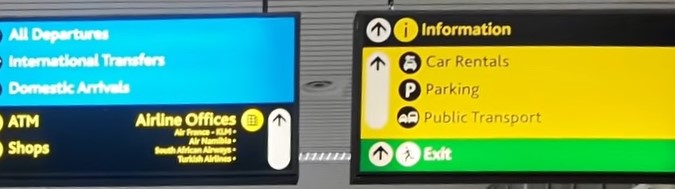
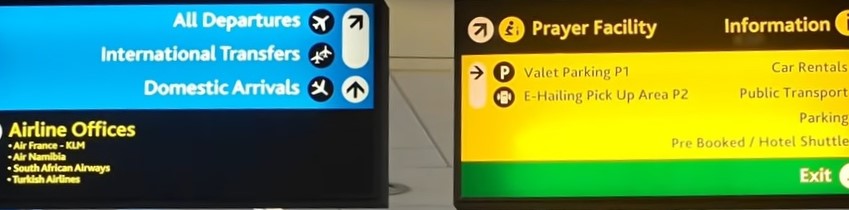
The first sign mentions public transport, the second you reach will mention "e-hailing" which is actually at P1. If you have a pre-booked hotel transfer you turn right at this sign.
After these 2 signs you'll be joining the main concourse of the airport, outside of which lies the transport area. You'll usually almost immediately be approached by a driver for a council-licensed taxi, what you would think of as a "yellow taxi" you see around the world. This is your most expensive option because your trip is metered. The drivers are vetted by the city, are honest, are knowledgeable and know the circumstances of the day for the route you require. In the unlikely event of there being an emergency, they'll know what to do. The downside is that their vehicles are not the newest.
Uber is ubiquitous in Cape Town and for good reason. There are other ride-share operators but in good conscience I can not recommend them. Uber does more thorough background checks on its drivers. Like Uber anywhere in the world, the cars are new, the price fixed and in SA incredibly cheap. Driving from the airport to the V&A Waterfront will cost - depending on the time of day - from R120 to R200 (up to US$13/£10) and take from 25 to 35 minutes depending on traffic.
There is a separate area in the car park of the airport (Parkade 1) where Uber drivers collect their riders. At the main concourse doors you turn right and look for a sign indicating several options on a pillar; look for "E-hailing Pick Up Area".
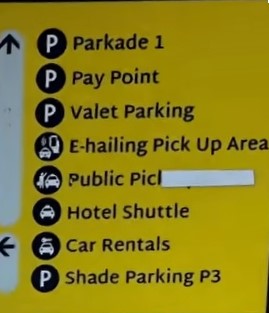
Walk in the direction indicated until you reach the entrance to Parkade 1 which is on your left. Enter the big doors and walk towards the next sign before the escalators that points to the right.
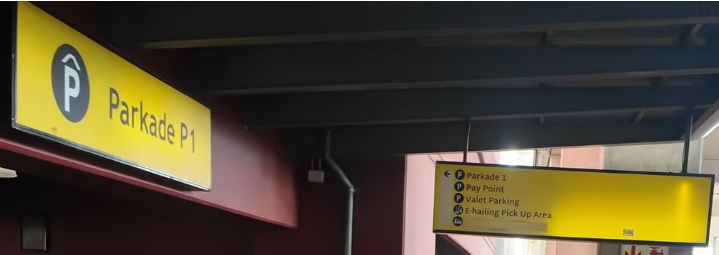
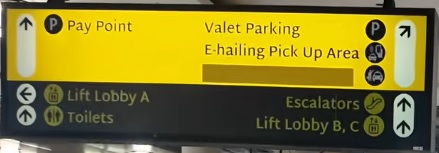
Next to the escalators you'll find a queue of people waiting for their Uber. Make sure you match the car's number plate with what the app shows and remain behind the guard rails.
You can pay in cash at the end of the trip if you wish but the app should take the fee from your account wallet. The conversion charges for foreign currency rides on Uber is not excessive. A cash tip of 10% is customary but if you don't have cash then it is possible to leave a gratuity on the app if you so wish.
Car Hire at Cape Town Airport
The famous global car hire names have their operations in individual offices directly outside the concourse of airport building. Smaller local operators (who are usually cheaper) often have their depot in the adjoining industrial area – they will take you to your vehicle and back to the airport when you return the vehicle. Normally you have to return the vehicle with the fuel tank full. Luckily there is a 24-hour BP petrol station at the entrance to the airport that you can use when you return. It's on the exit side of the road system, so coming back to the airport you'll need to do the big loop that is Ring Road to get to it, then use a service road behind the station to get back on to Ring Road. The price of fuel in South Africa is set by the government and it is the same all across the country. Just remember that here we drive on the left side of the road. (See my safety tips for more information about driving in SA.)
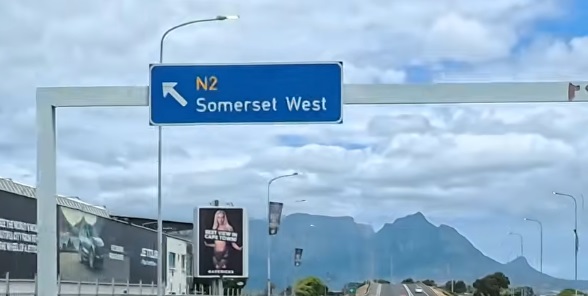
Leaving the airport by day is easy in that you have bright sunlight and you simply get on the N2 highway and head for Table Mountain to the west. It is a long circular bend that leads to the N2 motorway, you need to change lanes at times, so be aware.
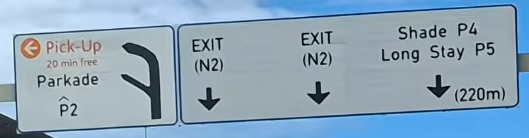
If you are heading away from Cape Town then take the exit for "N2 Somerwest West", otherwise keep on the multi-lane highway heading for the mountain. Unfortunately driving along this motorway past the sprawling shantytown of Khayelitsha is not a pleasant introduction to Cape Town. It tells you of the socio-economic challenges that face South Africa. Do not stop along this stetch of the road for any reason.
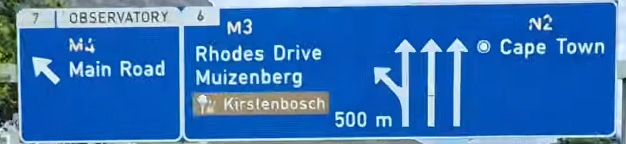
As you approach the mountain there will be signs for "M3 Rhodes Drive" - use that if your accommodation is in the Southern Suburbs. Otherwise just stay on the N2 and you'll be heading into the City Bowl and Atlantic Seaboard. At this point it is necessary to have a satnav working because there are many exits that lead to your final mile or two.
If Arriving Late at Cape Town Airport
Returning then to the aforementioned scenario of arriving on a late flight. You're tired, it's dark, it might even be raining, you don't know the road network and you're in the worst part of the city. What's the safe thing to do? A regular taxi is your safest bet because they are right there in front of the airport. Then, as second choice, an Uber might be willing to fetch you, but you might have to wait for while until they get to you. To avoid congestion and ugly competition Uber drivers are not allowed to congregate at the airport; they have to drop off and go. So they go find a spot outside the airport perimeter, hoping to get a rider going back into the city.
Standing around in the dark trying to inspect a rental car for existing scratches, then trying to get on the correct road, hoping that where you're staying is going to be there to receive you...stressful start. Yes, it is possible if it is the height of Summer and the sun is still up, but why do that to yourself? If you are confident about the roads ahead, then that is an option of course, but if is your first time in Cape Town, it is best to play safe.
A taxi or Uber to where you're staying is the safest move, unless you have booked a rental car in advance. You can always pick up a hire car the next day in the city or suburbs when you need it. Getting a taxi or Uber back to the airport also cuts out the hassle of returning the car at the airport. If you are going to need transport to somewhere other than Cape Town, such as to one of the nearby towns, then your own car is your only option.
If you are staying at one of the many 5-star hotels in the city, they might be able to collect you at the airport. You will need to enquire directly with their concierge about this, preferably at the time of making your booking. Small bed and breakfast operators sometimes also offer a meet-and-greet service at the airport, but are likely to charge for this. They will keep an eye on your flight arrival time and will be there if your flight is delayed.
Welcome to Cape Town!